
The Forensic Scene: When the Core Pulverizes
I was standing on a scaffold three stories up, looking at a historic textile mill that had survived two world wars and a dozen recessions. The homeowner, a well-meaning guy who had just bought the place, thought the fine orange dust on his windowsills was just ‘settling.’ I pulled out my masonry hammer and gave a light tap to a soldier course over the main entrance. The brick didn’t ring; it thudded like a wet log. As I pulled my scope through a hairline gap, I saw the structural steel was rusted to a jagged, flaky mess, and the mortar behind the face brick had quite literally turned into a pile of dry beach sand. This wasn’t just age; it was a systemic failure of physics and chemistry. This is what happens when modern ‘knowledge’ meets old-world reality.
The Physics of Porosity and the ‘Sacrificial’ Mud
To understand why your joints are crumbling, you have to understand the ‘tooth’ of the brick. Old-world masonry, particularly anything built before the 1940s, relied on a fundamentally different logic than the modular masonry construction we see today. The mortar was designed to be the sacrificial lamb of the wall. It was soft, breathable, and flexible. When moisture entered the wall—which it always does—the mortar joints were the exit ramp. They allowed water to evaporate out without damaging the brick. This is why we use lime-based muds. Lime doesn’t just ‘dry’; it undergoes a carbonation process. Over decades, it absorbs carbon dioxide from the air and turns back into limestone. It’s a living, breathing component of the structure.
“The use of mortar having a compressive strength higher than that of the masonry units can lead to distress during cycles of temperature change or moisture movement.” – BIA Technical Note 7B
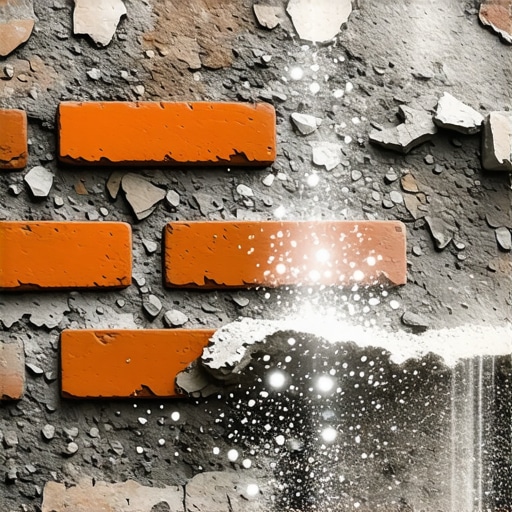
The problem starts when a modern ‘handyman’ decides to perform a cracked brick wall repair using a bag of high-strength Portland cement from a big-box store. They think ‘harder is better.’ Wrong. In the world of forensics, we call this a ‘death sentence.’ Portland cement is dense and non-porous. When you butter a joint with that hard stuff against a soft, 19th-century clay brick, you create a vapor barrier. Moisture gets trapped behind the hard cement. In the winter, that water expands by 9% as it freezes. Since it can’t escape through the hard cement joint, it pushes through the face of the brick, causing spalling, or it pulverizes the softer mortar behind it into sand. It’s a slow-motion explosion happening inside your walls.
[IMAGE_PLACEHOLDER_1]
Tuckpointing vs. Repointing: Don’t Get Scammed
I hear people use these terms interchangeably, and it drives me up the wall. Tuckpointing curved walls or flat facades is a specific aesthetic technique that uses two different colors of mortar to create the illusion of a perfect, thin joint. Repointing is the actual structural repair of the joints. If you’re paying for a restoration and the contractor isn’t grinding out the joints to a depth of at least twice the width of the joint, they aren’t fixing anything; they’re just ‘licking and sticking’ a thin layer of mud that will pop off in two seasons. You need to see a clean, square-cut groove where the new mud can get a mechanical bond—a ‘tooth’—to the brick. Without that, you’re just wasting money on a cosmetic band-aid.
The Chemistry of ‘Sand-Out’ and Masonry Staining
When the binder—the lime or cement—fails, you’re left with the aggregate: sand. This ‘sand-out’ can be caused by ‘burning’ the mud. If the brick is bone-dry when the mason applies the mortar, the brick will suck the water out of the mud too fast. This stops the hydration process dead in its tracks. The mortar never reaches its structural potential; it just dries out into a brittle, sandy paste. This is why we pre-wet the wall—a process called ‘controlling the suction.’ Furthermore, if you see masonry staining or white crusty powder (efflorescence), that’s a signal that water is moving through the wall and carrying salts to the surface. It’s the smoke before the fire. If you ignore it, you’ll eventually need concrete masonry unit restoration or, worse, foundation slab jacking if the water starts undermining the footings.
“Mortar should be designed to be weaker than the masonry units so that any stress-induced cracking occurs in the mortar joints, which are easier to repair than the units themselves.” – ASTM C270 Appendix
The Reality of Modern Solutions
In the commercial world, commercial masonry facade maintenance has moved toward robotic masonry repair for large-scale projects, but the physics remain the same. Whether it’s a modular retaining wall or a historic chimney, you cannot fight hydrostatic pressure. You have to manage it. If your retaining wall is leaning, it’s not because the blocks are bad; it’s because the drainage behind it is non-existent. The weight of water-logged soil is immense. Similarly, if you see honeycombing in a concrete patch, it means the mix wasn’t vibrated correctly, or the ‘mud’ was too stiff to flow around the rebar. It creates voids that invite rust, and rust expands, causing more cracks. It’s a cycle of decay that only a forensic approach can stop. Do it once, do it right, or get used to the smell of a damp, failing basement.