
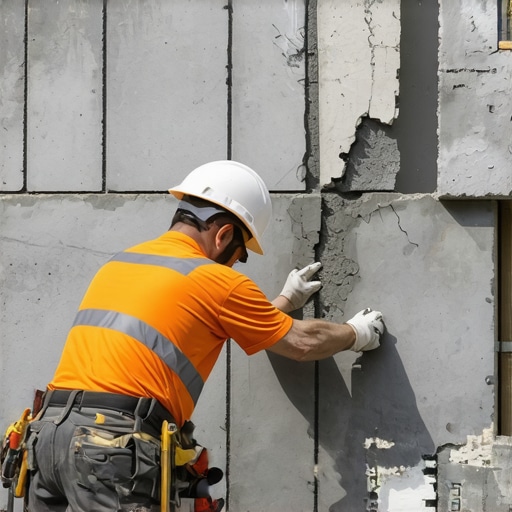
The Diagnostic Scream of a Vertical Split
When you walk onto a job site and see a vertical crack slicing through a modular block wall from the coping stone down to the grade, you aren’t just looking at a cosmetic blemish. You’re looking at a structural cry for help. In my thirty years of handling a hawk and trowel, I’ve seen homeowners try to slap a concrete patch over these fissures like a Band-Aid on a broken femur. It never works. A vertical crack in a Concrete Masonry Unit (CMU) wall is a specific symptom of a specific disease, usually related to thermal expansion or structural settlement. Unlike the stair-step crack that follows the mortar joints, a vertical break that shears right through the block itself tells you that the stress has exceeded the tensile strength of the masonry units. This is where the forensics begin.
The Forensic Scene: What the Borescope Revealed
The property owner thought it was just a hairline crack, a minor annoyance on a 20-foot commercial parapet wall. But when I put my digital scope inside the void, I saw the true horror: the internal structural steel was rusted to dust. The oxidation expansion of that rebar had acted like a slow-motion explosion from the inside out. Water had been seeping through a failed cap stone, saturating the hollow cores of the modular blocks. Because this was a southern exposure in a high-heat environment, the daily thermal cycling was brutal. The wall was expanding during the 100-degree afternoons, but with no control joints to breathe, it had no choice but to snap. The internal rebar, once meant to provide strength, had become a wedge of rust, forcing the masonry apart. This wasn’t a job for a handyman; it was a commercial parapet wall repair that required a total concrete masonry unit restoration.
“Movement joints are essential in concrete masonry to prevent cracking caused by internal and external forces, including thermal and moisture-related expansion and contraction.” – BIA Technical Note 18A
The Physics of the Thermal Engine
In hot climates, the sun is a physical weight on a masonry structure. Concrete masonry units have a coefficient of thermal expansion of approximately 0.0000055 inches per inch per degree Fahrenheit. On a long commercial wall, that translates to significant movement. If the mason who built the wall didn’t leave room for this growth—if they didn’t ‘butter’ the ears of the blocks correctly or provide a cold joint at the required intervals—the wall becomes a ticking time bomb. The mortar used in these walls is often too hard. In modern high-performance mortar mixes, we see an over-reliance on Portland cement, which creates a brittle bond. When the wall wants to move, the mortar won’t give, so the block breaks. This is why historic mortar analysis is so vital, even on mid-century modular buildings. We need to understand the ‘modulus of elasticity’—the ability of the mud to flex before it fails.
[image_placeholder]
Advanced Masonry Adhesives and the Chemistry of Repair
Restoring these walls requires more than just mixing a bag of Type S. We are now utilizing advanced masonry adhesives and epoxy injection systems that bond at a molecular level. When we perform a foundation crack repair, we aren’t just filling a hole; we are re-establishing the monolithic integrity of the unit. The concrete patch materials of today are polymer-modified, meaning they contain long-chain molecules that bridge the microscopic gaps in the old concrete. Before applying these, the ‘tooth’ of the crack must be prepared. You can’t just smear mud on a dusty surface. We use high-pressure air and sometimes an acid etch to ensure the suction of the block is primed for the new material. This is where AI masonry assessment is beginning to play a role, using thermal imaging and algorithmic stress mapping to predict where the next crack will appear based on the building’s orientation to the sun.
The Hydration Crisis: Why Mortar Fails
One of the biggest sins in modern masonry is ‘flash setting.’ In the heat of the South, if you don’t pre-wet your blocks, the dry concrete will suck the water right out of your mortar before it has a chance to hydrate. This leaves the mud crumbly and weak, a phenomenon we call ‘burning’ the joint. Proper masonry water damage repair starts with controlled hydration. The chemical reaction that creates Calcium Silicate Hydrate (C-S-H) crystals—the ‘glue’ of concrete—requires water to be present over a period of days, not minutes. When repairing vertical cracks in modular block walls, I ensure the repair zone is kept damp, allowing those crystals to grow into the pores of the surrounding block. This creates a mechanical lock that no simple surface coating can match.
“Water penetration is the single greatest threat to masonry durability, leading to efflorescence, freeze-thaw damage, and corrosion of embedded metals.” – BIA Technical Note 7
Green Roofing and the New Frontier of Moisture
We are seeing a massive trend in green roofing masonry integration. While these living roofs are great for the environment, they are a nightmare for the masonry if not detailed perfectly. The constant moisture at the roofline increases the hydrostatic pressure against the parapet walls. If the flashing is compromised, you get honeycombing in the concrete and accelerated masonry water damage repair needs. The moisture migrates down through the wall, carrying salts that crystallize and blow the faces off the blocks. When I’m called in for a forensic audit, the first thing I check is the drainage behind the wall. If there’s no way for the water to get out, it will find a way through the block, usually manifesting as a white, powdery efflorescence before the actual cracking begins.
The Solution: Do It Once, or Do It Twice
To truly fix a vertical crack, you must address the root cause. If it’s settlement, you’re looking at helical piers. If it’s thermal, you’re looking at retrofitting control joints. We use a slicker to finish the joints, ensuring they are ‘struck’ hard to compact the mortar and shed water. We don’t just ‘butter’ the edges; we ensure full head-joint saturation. For commercial parapet wall repair, we often install stainless steel ‘staples’ across the crack before concealing them with a matching high-performance mortar mix. This provides the tensile strength the concrete lacks. Don’t trust a guy with a caulk gun. Masonry is a game of physics, chemistry, and sweat. You either respect the materials, or they will eventually crumble at your feet.