
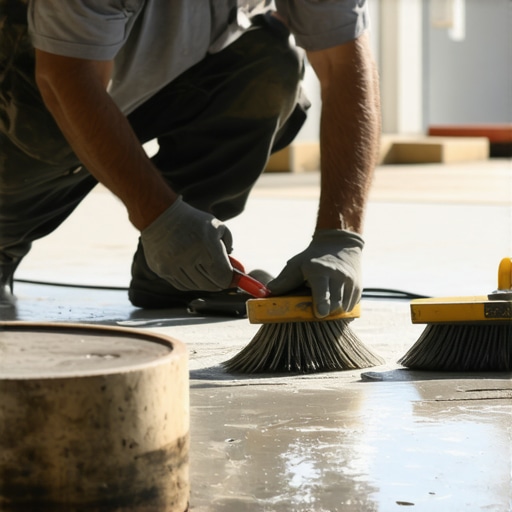
The Ghost of Silas and the Sins of the Surface
I remember my mentor, Old Silas, a man whose hands looked like they were carved from the very granite he set. He didn’t care about the speed of your buttering or the neatness of your soldier course if you hadn’t spent the morning prepping the substrate. He used to say that a mason who ignores the surface is like a doctor who stitches a wound without cleaning the gravel out of the dirt. He’d take a damp sponge and wipe the wall; if he saw a film of dust or a shimmer of old oil, he’d walk off the site and tell the homeowner to call a handyman. That’s the difference between a structure that stands for a century and one that fails before the first winter frost. Most of the ‘lick-and-stick’ stone veneer repair jobs I see failing today are because some kid thought he could just slap mud onto a dirty lath and call it a day.
In my thirty years of forensic structural inspections, the root cause of 90% of masonry failure isn’t the material itself; it’s the lack of mechanical and chemical ‘tooth’ at the interface. Whether we are talking about historic tuckpointing or modular masonry construction, the bond is everything. If the surface isn’t prepared, you aren’t building a wall; you’re just stacking heavy rocks and praying to the laws of gravity to hold them there. When a wall fails during a masonry rescue after disaster, it’s almost always because the bond between the old and the new was compromised by soot, salts, or simple negligence.
The Physics of the Bond: Why ‘Tooth’ Matters
To understand why surface prep is the holy grail of masonry, you have to micro-zoom into the molecular level of the mortar-brick interface. When you apply mud to a brick, you aren’t just creating a suction cup. You are facilitating a process called capillary suction. The brick literally pulls the water and the dissolved cementitious particles into its pores. This creates a mechanical interlocking system. If that brick is covered in a microscopic layer of dust, the water stops at the dust. It never enters the pores. You end up with a ‘cold joint’ that looks fine on the outside but has zero shear strength.
“The surface of the masonry units should be free of dust, dirt, oil, and any other foreign matter that would inhibit bond. If the units are dry, they should be dampened to reduce the rate of absorption of water from the mortar.” – BIA Technical Note 7: Water Resistance of Brick Masonry
This is especially critical in re-pointing services. If you don’t grind out the old, failing mortar to a depth of at least twice the width of the joint, and if you don’t brush out the loose grit and dampen the cavity, the new mortar will ‘flash dry.’ The old brick will suck the water out of the new mortar so fast that the cement hydration process stops. You’re left with a brittle, sandy mess that will fall out in three seasons. We call this ‘burning the joint,’ and it’s the mark of an amateur.
The Chemistry of Historic Restoration
When dealing with historic tuckpointing, the rules change because the physics of the materials change. Pre-1940s bricks are soft. They were fired at lower temperatures than modern modular bricks. If you use a modern, hard Portland cement on these soft bricks without proper surface prep, you will destroy the building. The mortar must be a ‘sacrificial’ element. It has to be softer than the brick. But even the best lime putty mortar won’t stick if the old masonry isn’t cleaned of biological growth like algae or lichen. These organisms secrete acids that turn the brick surface into a soft, powdery mush. Masonry waterproofing solutions often fail because they are applied over these salts (efflorescence) without a deep chemical cleaning, trapping the moisture inside and causing the face of the brick to pop off in a process we call spalling.
The Chimney: A Vertical Forensic Scene
Nowhere is surface prep more vital than in chimney sweep and repair. The inside of a chimney is a hostile environment of thermal shock and acidic condensate. If you are performing chimney interior parging, you are working against gravity and creosote. Creosote is basically a waterproof oil. If you don’t scrub that flue down to the bare clay or masonry before applying a parge coat of fiber-reinforced mortars, that parging will delaminate and fall like a curtain, potentially blocking the flue and sending carbon monoxide back into the house. It’s not just about aesthetics; it’s about life and death. The same applies to an outdoor fireplace rebuild. The thermal expansion of the firebricks is so extreme that any imperfection in the bond will lead to structural cracking within the first five fires.
The ‘Lick-and-Stick’ Epidemic
Modern stone veneer repair is the bane of my existence. I’ve seen $2 million homes where the stone is falling off the side of the house because the ‘masons’ didn’t understand the scratch coat. They apply the metal lath, but they don’t use a weather-resistant barrier (WRB) correctly, or they don’t ‘scratch’ the first coat of mortar to create the horizontal grooves that provide the mechanical lock for the stones. They just butter the back of the stone and press it on. Without that mechanical tooth, the stone is only held by the surface tension of the wet mud. As soon as the sun hits that wall and it undergoes thermal expansion, the stone pops off, exposing the OSB behind it to rot. It’s a disaster waiting to happen, and it all comes back to skipping the prep work.
“Proper surface preparation is not merely a preliminary task; it is a fundamental requirement for the durability and structural integrity of any masonry assembly.” – ASTM C270 Standard Specification for Mortar
The Master Mason’s Prep Protocol
If you want a job to last, you follow the protocol. First, the mechanical cleaning. You use a slicker or a brush to remove the loose material. Then, you address the ‘suction’ of the material. In hot climates, we talk about Saturated Surface Dry (SSD) condition. You soak the wall with water until it stops drinking, then let the surface sheen disappear. Now, when you apply your mud, the brick doesn’t rob the mortar of its hydration water. The cement crystals grow into the pores of the brick, creating a bond that is actually stronger than the materials themselves. This is the only way to ensure masonry waterproofing solutions actually penetrate the substrate rather than just sitting on top like a layer of cheap paint.
Don’t let a contractor tell you they can ‘save time’ by skipping the wash-down or the grinding. In this trade, time saved on prep is just time added to the eventual failure. Whether you are doing a simple repair or a full modular masonry construction project, the prep is the project. Everything else is just decoration. If the tooth isn’t there, the wall won’t bite. And a wall that won’t bite won’t stand.