
The Echo of the Stone: A Legacy of Precision
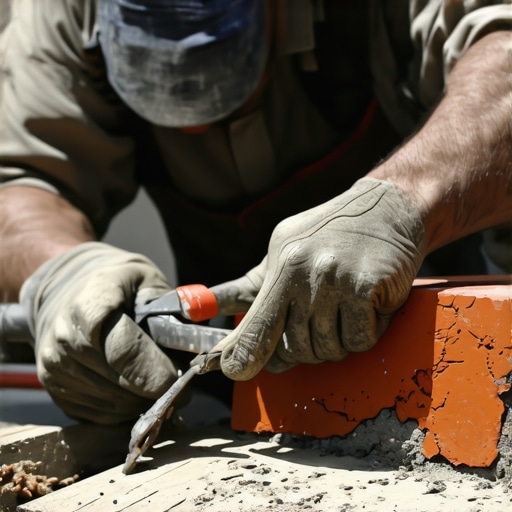
My great-uncle Silas used to hold a shale brick to his ear and rap it with the handle of his Rose trowel. He wasn’t listening for ghosts; he was listening for the ‘ring.’ If the brick emitted a high-pitched, metallic clink, it was sound. If it gave a dull, hollow thud, it was ‘blown’—internally fractured during the firing process—and he’d heave it into the rubble pile without a second thought. I remember watching him hand-carve a birdsmouth notch for a 45-degree corner on a 1920s Tudor restoration. He didn’t use a laser-guided saw. He used a scutch hammer and a steady hand. He knew that a birdsmouth isn’t just a decorative angle; it is a structural necessity that, if botched, creates a direct highway for water to bypass the brick veneer and rot the substrate. When you see a building suffering from brick veneer detachment repair issues later in its life, it is often because some ‘mechanic’—I won’t call them a mason—tried to fake a birdsmouth by butting two square edges together and filling the gap with a gallon of ‘mud.’
“Water penetration is the single greatest threat to masonry durability, accounting for over 90% of premature failures in residential systems.” – BIA Technical Note 7
The Physics of the Notch: Why Geometry Matters
In the world of forensic masonry, we see the failures that ‘handyman specials’ leave behind. A birdsmouth fit requires notching a V-shape into the face or header of a brick so it can wrap around an external corner or sit flush against a non-orthogonal wall. The physics here are brutal. When you notch a brick, you are creating a stress concentrator. If the internal corner of that notch is a sharp, jagged right angle, thermal expansion will eventually cause a ‘spider-web’ crack to radiate from that point. Micro-zooming into the material science, a fired clay brick is a ceramic. It excels in compression but is brittle in tension. As the wall heats up in the afternoon sun—reaching temperatures of 140 degrees Fahrenheit—the brick expands. Without a clean, precision cut and the right tuckpointing weatherproofing, that notch becomes the site of structural failure. This is why we advocate for sustainable masonry materials that match the modulus of elasticity of the original wall. Using a hard, modern Portland cement in a notch on a soft, 19th-century brick is like putting a steel bolt through a piece of balsa wood; something is going to snap, and it won’t be the steel.
The Anatomy of the Cut: Tools and Technique
To achieve a clean birdsmouth, you need to understand the ‘suction’ of the brick. If the brick is too dry, it will pull the water out of your mortar (the mud) so fast that the bond never forms, a process we call ‘burning the joint.’ Before you even think about the saw, you must check the Initial Rate of Absorption (IRA). I always carry a spray bottle. If the water disappears instantly, those bricks need a soak. When cutting the notch, the ‘kerf’—the width of the blade—must be accounted for. I’ve seen guys ruin a whole soldier course because they forgot that a diamond blade eats 1/8th of an inch of material. We use self-leveling masonry lifts to ensure the work platform is perfectly plumb, because even a 1/16th-inch lean at the base becomes a disaster when you’re trying to align birdsmouth cuts three stories up. For historic work, we stay away from high-speed dry cutting. The heat-affected zone (HAZ) created by a dry blade can actually ‘glaze’ the interior of the cut, preventing the mortar from achieving a mechanical ‘tooth’ within the brick’s pores.
The Mortar Science: Why ‘Breathability’ is Non-Negotiable
Once the brick is notched and ‘buttered,’ the choice of mortar determines the next century of that wall’s life. In historic restoration, we often see the damage caused by ‘tuckpointing’ done with Type S mortar on old lime-based walls. It’s a tragedy. The mortar must be the sacrificial lamb.
“The mortar shall be the sacrificial element of the wall, designed to fail before the masonry unit itself, ensuring that moisture can evaporate through the joints rather than being trapped behind the face of the brick.” – ASTM C270 Standard Specification
If you use a mortar that is harder than the brick, the freeze-thaw cycle will turn the brick face to powder, a process called spalling. For a birdsmouth fit, which is inherently more exposed to the elements, we utilize flush pointing services with a high-lime content. This allows for autogenous healing—where the lime actually migrates into small cracks and reseals them over time through carbonation. We also look at chimney interior parging as a parallel discipline; if the ‘throat’ of the masonry isn’t smooth and breathable, the whole system fails from the inside out. For modern applications, mortarless masonry systems are gaining ground, but they lack the ‘soul’ and the moisture-shedding capabilities of a hand-struck joint.
Finishing and Maintenance: Beyond the Trowel
After the birdsmouths are set, the aesthetic and protective finish begins. Masonry staining can be used to match the new notched units to the weathered originals, but it must be a breathable silicate-based stain, not a latex paint that will peel like a bad sunburn. We also see issues with patio stone realignment where birdsmouth cuts in pavers weren’t properly compacted, leading to ‘wavy’ ground. The real secret to longevity is tuckpointing weatherproofing. This involves striking the joint with a slicker to compress the surface of the mortar, creating a ‘skin’ that sheds water like a duck’s back. If you leave the ‘mud’ shaggy, you’re just inviting ice to move in and start prying your hard work apart. Don’t fall for the ‘lick-and-stick’ veneer scams that use adhesives instead of mechanical bonds. A real mason knows that the only thing holding a building up is gravity, geometry, and a deep respect for the chemistry of the earth. Do it once, do it right, or don’t do it at all. The stone doesn’t lie, and it doesn’t forgive laziness.