
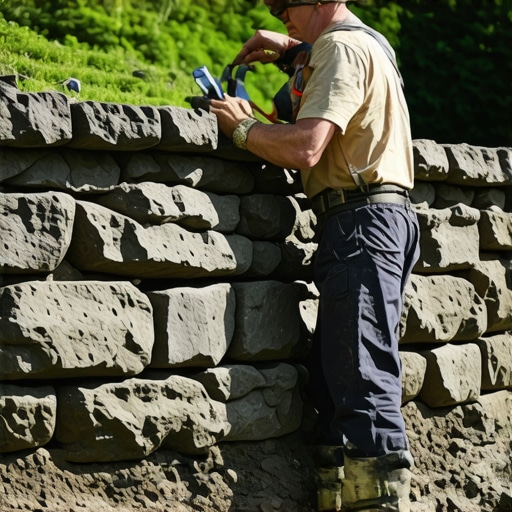
The Groan of the Earth: Why Your Stone Wall is Bowing
I remember a project out in a low-lying valley where a homeowner called me to look at a $70,000 fieldstone wall that was starting to look like a pregnant belly. The contractor who built it had the best intentions, but he treated the earth like it was a static painting rather than a living, breathing hydraulic jack. I stood there looking at that 100-foot-long pile of rubble-to-be, and I could practically hear the soil whispering to the stone. It wasn’t a structural failure of the rock; it was a failure of the physics behind it. The contractor forgot the golden rule: water doesn’t ask for permission, it takes what it wants. When the rain saturated that heavy clay soil, the lateral pressure exceeded the gravity-load capacity of the wall. Without proper foundation underpinning or a way for that water to escape, the stone simply yielded. This is the reality of masonry forensics—it’s never just about the stone; it’s about the invisible forces pushing against it.
“Retaining walls should be designed to resist the pressure of the retained material, including any surcharge, and to prevent sliding and overturning.” – BIA Technical Note 15
In the trade, we talk about the ‘tooth’ of a stone—that rough surface that allows the mud to grab hold and create a mechanical bond. But even the best bond won’t save a wall built on a shifting base. If you’re in the North, you’re fighting the freeze-thaw cycle. Water expands 9% when it turns to ice. Imagine that expansion happening a billion times inside the microscopic pores of your mortar and the soil behind your wall. If you haven’t used sustainable tuckpointing mortars that can breathe, that ice will pop the face of your stone off like a bottle cap. Here are the three fixes that actually work, from a man who has spent forty years with a hawk in one hand and a slicker in the other.
1. The Foundation: Underpinning and Base Stabilization
If your wall is leaning, the first place I look is the ‘toe.’ The toe is the bottom edge of the wall where it meets the ground. When a wall starts to rotate forward, it’s often because the soil underneath the front edge is compressing. We use foundation underpinning to transfer the weight of the wall to deeper, more stable soil or rock. This isn’t a ‘handyman special’ fix; it involves excavating sections and pouring concrete piers or installing helical piles. While we’re down there, we look for honeycombing in the original concrete footing—those nasty air pockets where the mud wasn’t vibrated properly, leading to structural weak points. For modern forensic work, we now utilize digital twin masonry projects to map the exact movement of the wall over time, allowing us to see if the lean is active or dormant before we start digging. This level of precision prevents the ‘over-engineering’ that costs homeowners a fortune while ensuring the wall won’t budge for another century.
2. The Hydraulic Escape: Drainage and Hydrostatic Relief
You can build a wall ten feet thick, but if you don’t give the water a place to go, that wall is coming down. Hydrostatic pressure is the weight of the water trapped in the soil. At 62.4 pounds per cubic foot, saturated earth can exert thousands of pounds of pressure against the back of your stonework. The fix is a combination of clean #57 stone backfill and weep holes. But in cases of severe leaning, we often have to implement robotic masonry repair techniques to drill through the existing structure and install supplemental drainage systems without dismantling the entire facade. We also look at the concrete flatwork services around the top of the wall. If your patio or walkway is sloping toward the wall instead of away from it, you’re just funneling fuel into the fire. A proper cap, perhaps a soldier course of brick or a heavy limestone coping, should shed water away from the wall’s core to prevent it from ever getting behind the stone in the first place.
3. The Skin: Structural Repointing and Mortar Science
Once the wall is stabilized from the bottom and the water is diverted, we have to address the ‘face.’ This is where I see the most ‘lick-and-stick’ crimes. Some guy comes in with a bag of high-strength Portland cement and ‘butters’ the joints of an old stone wall. That’s a death sentence. High-strength cement is too rigid; when the wall moves slightly (and it will), the cement won’t flex. Instead, it will crack the stone itself. We use mortar matching services to analyze the original lime-to-sand ratio.
“The choice of mortar for a particular masonry application should be based on the properties of the masonry units and the exposure conditions.” – ASTM C270 Standard Specification for Mortar
We perform structural repointing using sustainable tuckpointing mortars that are designed to be ‘sacrificial.’ The mortar should always be slightly softer than the stone. This way, any stress or moisture is handled by the joint, which can be easily repaired, rather than the stone, which cannot. For those massive stones that have shifted out of alignment, we employ self-leveling masonry lifts to gently nudge them back into place before buttering the joints with fresh, color-matched mud. If the stones are loose, we might even look at masonry joint sand repair for the base layers to ensure the interlocking friction is restored. Whether you’re doing an outdoor fireplace rebuild or a 50-foot retaining wall, the material science remains the same: respect the stone, manage the water, and never trust a contractor who doesn’t have mud on his boots.