
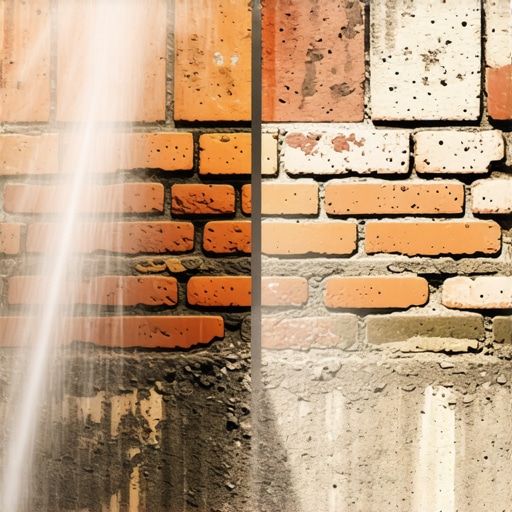
The Forensic Scene: A Facade Stripped of Its Soul
I stood on a job site last Tuesday looking at a 1928 Tudor revival that looked like it had been through a sandstorm. The homeowner, a well-meaning guy who spent too much time on weekend warrior forums, decided to ‘freshen up’ his exterior with a rented 4000 PSI pressure washer. What he didn’t realize was that he wasn’t just removing dirt; he was performing a lobotomy on his masonry. When I put my macro-lens to the surface, the damage was catastrophic. The protective ‘firing skin’ of the brick—that vitrified, glassy layer formed in the kiln—was gone. In its place was a pockmarked, fuzzy mess of raw clay, now as porous as a kitchen sponge. This is the reality of modern ‘maintenance’ meeting old-world physics. It’s a tragedy written in PSI and ignorance.
The Anatomy of a Brick: Why Pressure is Poison
To understand why high-pressure water is the enemy, you have to look at the micro-structure of the unit. A brick isn’t a solid, inert block; it is a complex network of capillary pores. During the firing process, the minerals on the surface melt and fuse together to create a dense, weather-resistant shield. Underneath that shield lies the ‘heart’ of the brick, which is much softer and more susceptible to environmental decay. When you hit that surface with a concentrated jet of water, you are essentially sandblasting with a liquid medium. You strip away the vitrification, opening up the internal pore structure to the elements. Once that skin is breached, the brick’s life expectancy drops from centuries to a few decades.
“High-pressure water cleaning can cause irreparable damage to the brick surface and should be avoided, particularly on older or handmade units.” – BIA Technical Note 20
The Hydration Trap and Efflorescence
Beyond the surface abrasion, pressure washing forces thousands of gallons of water deep into the wall assembly. In a standard rain event, gravity and surface tension keep most water on the exterior. But a pressure wand forces moisture into the cracked brick wall repair zones and deep into the mortar beds. This water then lingers in the wall for weeks. As it eventually migrates back to the surface, it brings soluble salts with it. This results in efflorescence—that white, chalky staining that looks like a salt mine erupted on your house. Worse yet, if you’re in a climate where the temperature swings, that trapped water undergoes the 9% expansion of the freeze-thaw cycle. Since the water has no room to expand within the pore, it simply shatters the brick from the inside out, a process we call spalling.
Sustainable Block Cutting and the Restoration Reality
When we approach a concrete masonry unit restoration or a historic brick project, we don’t reach for the power washer. We reach for low-pressure steam or chemical cleaners with a pH-neutral profile. We focus on sustainable block cutting to replace units that are too far gone, rather than trying to ‘save’ a ruined face. If the joints are failing, we don’t just ‘smear’ new mortar over the old. That’s a ‘handyman special’ that leads to water being trapped behind the new layer. We perform tuckpointing curved walls and straight runs by grinding out the old, failing mud to a depth of at least twice the joint width, ensuring a mechanical bond that actually keeps the water out.
The Breathability Factor: Lime vs. Portland
The greatest sin of modern masonry is the use of hard Portland cement on soft, historic bricks. In the old days, we used lime-based mortars. Lime is ‘sacrificial.’ It is softer and more vapor-permeable than the brick itself. This allows the wall to ‘breathe.’ Moisture travels through the mortar joints and evaporates, leaving the bricks dry and healthy. When a modern contractor uses Type S mortar (which is incredibly hard) to patch an old wall, the moisture gets trapped in the brick. Because the brick is now the softest part of the assembly, it becomes the sacrificial element. The mortar stays perfect, while the bricks crumble into dust.
“Mortar should always be weaker than the masonry units it binds, ensuring that stresses and moisture movement do not cause unit failure.” – ASTM C270 Standards
Forensic Inspections: From Drones to Foundations
Sometimes the damage isn’t visible from the ground. We now utilize drone chimney inspections to look at the ‘wash’ and the crown. Often, high-pressure washing on a chimney stack will blow out the chimney cap’s seal, leading to internal saturated flues. If the moisture reaches the bottom of the structure, you start seeing foundation waterproofing issues. Hydrostatic pressure builds up behind the wall, and suddenly that small hairline crack in the basement is a structural emergency. In these cases, we might look at self-leveling masonry lifts or helical piers to stabilize the movement, but it all started with water getting where it didn’t belong.
The Art of the Repair: Joint Sand and Water-proofing
For horizontal surfaces, the stakes are just as high. A masonry joint sand repair on a patio or walkway requires precision. Blasting the joints clean with a pressure washer often disturbs the compacted sub-base, leading to the dreaded ‘wavy’ driveway. Instead, we use masonry waterproofing solutions that are silane or siloxane-based. These are not ‘sealers’ in the sense of a plastic coating; they are penetrants that change the surface tension of the pores, making them hydrophobic while remaining vapor-permeable. This allows the ‘breath’ to continue while keeping the ‘bulk’ water out.
The Professional Path: Rebuilding with Integrity
If you’ve already had a ‘pro’ come out and blast your home with high pressure, the damage is done, but it can be mitigated. We look at an outdoor fireplace rebuild or a facade restoration as a surgical process. We ‘butter’ each replacement brick with the correct ‘mud’—Type N or Type O for historic work—ensuring the soldier course is perfectly aligned and the slicker is used to create a weather-struck joint that sheds water naturally. We don’t use ‘cold joints’ where new wet material meets dry without proper prep; we ensure the tooth of the masonry is ready to receive the new material. Masonry is a game of patience and physics. It’s about understanding that a wall is a living, breathing thing. If you treat it with violence—like a 4000 PSI blast—it will fight back. If you treat it with the respect the old masters intended, it will stand for another hundred years. Skip the pressure washer. Call a mason who knows the difference between clean and destroyed. Your house will thank you with its longevity.