The Deception of the Vertical Horizon
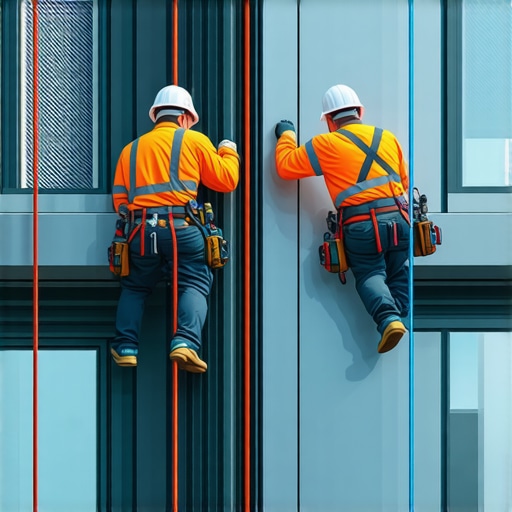
In the world of commercial masonry maintenance, gravity is a relentless auditor. It doesn’t care about your quarterly budgets or your ‘handyman specials.’ It only cares about the physical bond between the units and the substrate. I remember a property manager in the city who thought a vertical fissure on the 14th floor was just a hairline crack—the kind you’d ignore on a garden wall. But when I put my scope inside the cavity, I saw the structural steel was rusted to dust. The entire brick skin was essentially floating, held up by nothing but the grace of friction and a few remaining rusted ties. One high-wind event, and that building would have shed its skin like a snake, raining two-pound clay missiles onto the sidewalk below. This is the reality of forensic structural inspection: by the time you see the crack, the failure has been decades in the making.
1. The Lintel & Shelf Angle Integrity: Beyond Oxide Jacking
The most common failure point in high-rise masonry is the hidden steel. When we talk about brick lintel replacement, we aren’t just swapping out a piece of iron; we are fighting the physics of oxide jacking. When steel rusts, it expands up to ten times its original thickness. This exerts thousands of pounds of pressure on the surrounding masonry.
“Water penetration is the single greatest threat to masonry durability, particularly when it facilitates the corrosion of embedded metals.” – BIA Technical Note 7
During a structural masonry inspection, we look for ‘heaving’ joints above windows and doors. If the steel is flaking, the ‘mud’—our trade term for mortar—will pop right out. On high-rises, this often requires masonry birdsmouth cuts to properly fit new units around restructured steel supports. This isn’t a job for a guy with a bucket and a ladder; it requires a deep understanding of load-bearing physics and the use of stainless steel or hot-dipped galvanized angles to ensure the next fifty years are leak-free.
2. The Science of Tuckpointing Weatherproofing
People use the term tuckpointing brick walls like they’re talking about icing a cake. It’s not about aesthetics; it’s about vapor permeability and the ‘suction’ of the brick. Modern high-rise facades often suffer from previous ‘bad’ repairs where someone used a high-strength Portland cement on a softer, older brick. This is a death sentence. The mortar must be the sacrificial lamb of the wall.
“The compressive strength of the mortar should never exceed the compressive strength of the masonry units; otherwise, the brick itself will fail during thermal expansion.” – ASTM C270
In my years of commercial masonry maintenance, I’ve seen ‘burned’ mortar joints where the water was sucked out of the mud too fast by a dry brick, leaving a crumbly, non-bonded mess. We use a ‘hawk’ and ‘slicker’ to compress the joint, ensuring the tooth of the stone or brick is fully engaged. Tuckpointing weatherproofing requires a specific moisture-to-binder ratio that allows the building to ‘breathe.’ If you trap moisture behind a hard, non-permeable joint, the freeze-thaw cycle will pop the faces off your bricks (spalling), and you’ll be looking at a multi-million dollar liability claim when those faces hit the pavement.
3. Foundation Stability and Helical Intervention
A high-rise is only as stable as the soil it sits on. Hydrostatic pressure is a silent killer, pushing against the foundation with a force that can buckle reinforced concrete. If we detect ‘stair-step’ cracking in the lower masonry courses, we aren’t looking at a surface issue; we’re looking at a settlement issue. This is where foundation helical pier installation becomes the only viable ‘cure’ versus a ‘band-aid.’ These piers are essentially giant screws driven deep into the load-bearing strata of the earth. We then bracket them to the building’s footings to stop the sink. While self-healing concrete foundations are an emerging tech in new builds—using bacteria to bridge micro-cracks—for the existing high-rise stock, we rely on the raw physics of steel and torque. Neglecting concrete flatwork services around the perimeter also contributes to this; if your sidewalks aren’t pitched correctly, you’re just funneling water into your foundation, inviting the very settlement that requires piers in the first place.
4. Stone Wall Repair and Structural Skin Failure
Many high-rises utilize a stone veneer, which brings its own set of forensic headaches. Unlike brick, which has a predictable pore structure, stone wall repair involves managing various densities and ‘clefts.’ In high-rise applications, the ‘buttering’ of the stone—how the mortar is applied to the back—is critical. If a ‘cold joint’ is formed during the pour or the set, the bond is compromised. We check for ‘honeycombing’ in the substrate, which are air pockets that trap water. When that water freezes, it expands by 9%, and that expensive stone panel becomes a liability. A proper structural masonry inspection doesn’t just look at the surface; we use thermal imaging to find those pockets of moisture before they turn into mechanical failures. Whether it’s a soldier course of brick or a granite slab, the physics of thermal expansion must be accounted for with proper relief joints. Without them, the wall will eventually buckle under its own weight, a phenomenon known as ‘bowing’ that precedes a catastrophic collapse. In this trade, there are no shortcuts. You either respect the mud and the stone, or the building will eventually remind you why you should have.