
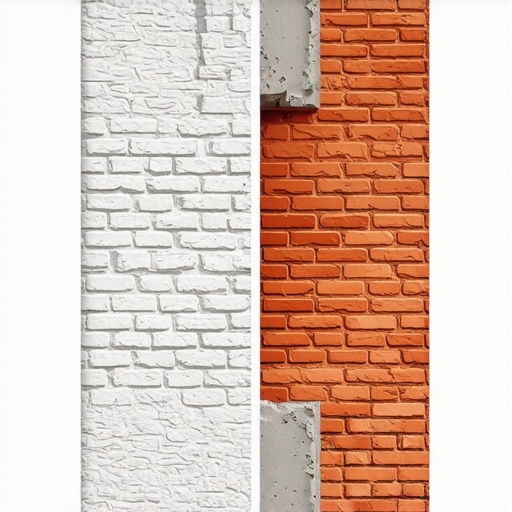
The Forensic Scene: When a Hairline Crack Becomes a Structural Autopsy
The homeowner called me out to look at a minor cosmetic issue on a 1920s Tudor revival. To the untrained eye, it was just a few hairline fissures running through the mortar joints. But as I pulled my scope and peered into the cavity, the truth was far more grim. The previous ‘contractor’ had performed a classic ‘lick-and-stick’ job—smearing a thin layer of hard Portland cement over crumbling lime mortar. Behind that grey mask, the structural steel lintel was rusted to a pile of orange dust, and the brick veneer detachment had progressed to a point of no return. This wasn’t a repair; it was a crime scene of masonry negligence. I’ve spent forty years in the mud, following in the footsteps of a grandfather who taught me that masonry isn’t just stacking rocks—it’s a delicate dance of chemistry and physics that most modern crews simply don’t understand.
The Physics of Breathability and the Sacrificial Principle
In professional masonry restoration, the golden rule is simple: the mortar must always be softer than the brick. This is known as the sacrificial principle. When I walk a job site and see a hard, high-PSI Type S mortar being used on soft, historic orange-clay bricks, I know that wall is doomed. Bricks are essentially porous sponges. They breathe, they move, and they absorb moisture. In a northern freeze-thaw environment, water is the primary antagonist. When water enters a brick and the temperature drops below 32 degrees Fahrenheit, that liquid expands by roughly 9% in volume. If the mortar joint is too hard, the pressure has nowhere to go. Instead of the mortar compressing, it forces the face of the brick to explode. This is the root cause of brick spalling prevention failures. You see the face of the brick lying on the sidewalk because someone used a ‘quick patch’ instead of a high-performance mortar mix designed for the specific modulus of elasticity of the masonry unit.
“Mortar should be designed to be ‘sacrificial.’ It must be more permeable and softer than the masonry units to ensure that moisture evaporation and structural stresses occur within the mortar rather than the brick.” – BIA Technical Note 1: All-Weather Masonry Construction
The Micro-Chemistry of Professional Mortar Repointing Services
True mortar repointing services aren’t about aesthetics; they are about restoring the capillary path for moisture. When we grind out a joint—never deeper than half the width of the joint unless structural stability is compromised—we are looking for the ‘tooth’ of the stone or brick. We don’t just ‘butter’ the edges. We look for the point where the original lime has carbonated over a century. Modern Portland cement hydrates quickly, forming a rigid crystalline lattice. Historic lime mortar, however, undergoes carbonation, absorbing CO2 from the air to turn back into calcium carbonate. This process allows for ‘autogenous healing,’ where microscopic cracks in the mortar can actually reseal themselves over time. If you use a ‘quick patch’ from a big-box store, you are sealing the wall’s lungs. The result? Brick veneer detachment repair becomes an inevitability as the hydrostatic pressure builds up behind that impermeable barrier, eventually pushing the entire facade away from the framing.
Chimney Anatomy: Interior Parging and Rebuild Services
Chimneys are the most abused masonry elements on any structure. They are attacked by rain from the outside and acidic combustion byproducts from the inside. Many ‘handyman’ fixes involve slapping some mortar on the outside of a leaning stack. A real chimney rebuild service understands the physics of the flue. Chimney interior parging is a specialized technique where we apply a smooth coat of refractory mortar to the inside of the smoke chamber. This isn’t just for fire safety; it’s about draft physics. A rough, honeycombed interior creates turbulence, slowing down the exit of gases and allowing creosote to latch onto the ‘cold joints’ of the masonry. When the interior parging fails, the moisture from the exhaust seeps into the brickwork, leading to rapid deterioration from the inside out. If your chimney looks ‘melted,’ it’s because the internal chemistry has turned the mortar into a mushy paste that can no longer support the soldier course at the crown.
The Hardscape Truth: Patio Stone Realignment and Compaction
I see it every spring: a ‘wavy’ driveway or a patio that looks like a topographical map of the Swiss Alps. The culprit is always the base. Most crews throw down two inches of screenings and call it a day. Brick patio restoration starts six to eight inches underground. We talk about the ‘Proctor density’—the measure of soil compaction. Without a properly graded and compacted 3/4-inch minus gravel base, patio stone realignment is just a temporary fix. You have to account for the capillary break. If the base doesn’t drain, the freeze-thaw cycle will heave those stones every single winter. We use a hawk and a slicker to ensure our joints are packed tight, but the real work is in the excavation. If you don’t do it once with a vibratory plate compactor and proper geotextiles, you’ll be doing it twice within three seasons.
“The durability of a masonry wall is dependent on the ability of the system to shed water. Improperly flashed or poorly pointed walls are the leading cause of premature structural failure.” – ASTM C270 Standard Specification for Mortar for Unit Masonry
Foundation Waterproofing: More Than a Bucket of Tar
Finally, we have to talk about foundation waterproofing. A ‘quick patch’ on a basement wall is like trying to stop a dam break with a piece of gum. Real professional masonry restoration at the foundation level requires addressing the hydrostatic pressure. When I see white, fuzzy powder on a basement wall—efflorescence—I know that water is migrating through the concrete or stone and bringing salts to the surface. Scraping it off and painting it with a ‘waterproof’ sealer actually accelerates the damage. It traps the water inside the masonry unit, causing the interior of the block or stone to turn to sand. True waterproofing involves exterior excavation, installing a dimpled drainage membrane, and ensuring that the weeping tile system is actually pulling water away from the footings. It’s gritty, expensive work, but it’s the only way to stop the structural rot that eventually leads to horizontal shear cracks—the kind of cracks that mean your house is moving, and not in a good way.
Conclusion: The Value of the Master’s Touch
In this industry, you get what you pay for. You can hire a guy with a truck and a trowel who will ‘smear’ your joints for a few hundred bucks, or you can hire a forensic mason who understands the carbonation of lime, the physics of thermal expansion, and the chemistry of high-performance mortar mixes. One is a cosmetic band-aid that masks a deepening wound; the other is a structural cure that will keep your home standing for another century. Don’t let a ‘quick patch’ turn into a total loss. Demand the science, demand the history, and never settle for a joint that doesn’t ‘ring’ like a bell.