
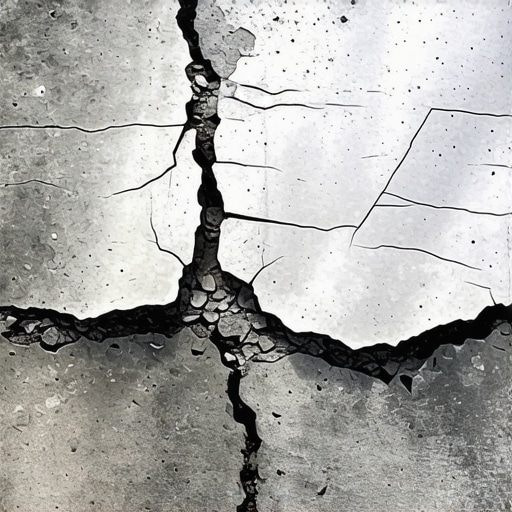
The Deception of the Hairline Fracture
I was standing in a damp, low-lit basement in a valley town where the humidity clings to the stone like a wet wool blanket. The homeowner was pointing at what he called a ‘minor annoyance’—a vertical crack in the foundation wall no wider than a nickel. He’d smeared a thick, gray paste of big-box store hydraulic cement over it six months prior. To him, it looked fixed. But when I slid my fiber-optic borescope into a relief hole I drilled, the reality was grim. Behind that stiff, brittle patch, the structural steel rebar was ‘blooming’—a trade term for oxidation so severe the metal expands to three times its original size, effectively exploding the concrete from the inside out. The ‘patch’ was merely a mask, hiding a slow-motion structural collapse that no amount of surface-level ‘buttering’ could stop.
The Physics of the Cold Joint: Why New Mud Hates Old Mud
The primary reason a weekend warrior’s concrete patch fails before the first anniversary is the phenomenon known as a ‘cold joint.’ Concrete isn’t just a rock; it’s a chemical reaction in a perpetual state of evolution. When you slap a fresh batch of high-performance mortar mixes onto a slab that has been curing for twenty years, you aren’t creating a unified material. You are attempting to bond two alien surfaces with vastly different densities, moisture contents, and thermal expansion coefficients. In the masonry world, we talk about the ‘tooth’ of the substrate. Without mechanical profiling—grinding the old surface to expose the aggregate—the new mud simply sits on top, held by a weak chemical handshake that vanishes the moment the temperature shifts.
“Water penetration is the single greatest threat to masonry durability, often exacerbated by incompatible repair materials that trap moisture within the substrate.” – BIA Technical Note 7
The Freeze-Thaw Meat Grinder
In northern climates, we deal with the brutal physics of the freeze-thaw cycle. When water penetrates the microscopic gap between your patch and the original wall, it waits. As the mercury drops, that water expands by exactly 9% in volume. This isn’t a gentle push; it’s a hydraulic jack. Because that cheap DIY patch is usually harder and less flexible than the surrounding material, it lacks the ‘give’ required to survive this expansion. The result? Spalling. You’ll find your patch lying on the driveway in the spring, looking like a discarded scab, while the original crack has now widened to accommodate the ice that tore it open.
The Chemistry of Suction and Hydration
Most handymen fail to account for the ‘thirst’ of old concrete. Dry, aged masonry has incredible suction. When you apply fresh mud, the old wall instantly sucks the water out of your mix before the cement crystals—the portlandite—have a chance to grow and interlock. This ‘burns’ the mortar. You end up with a crumbly, dusty mess that looks like concrete but has the structural integrity of a sugar cube. Professionals mitigate this through Saturated Surface Dry (SSD) techniques and sometimes historic mortar analysis to ensure the new material doesn’t fight the old. If you’re working on a pre-war home, using modern Portland cement is a death sentence for the brick; the mortar must be the sacrificial element, softer than the masonry unit itself, which is why sustainable tuckpointing mortars are making a massive comeback in the forensic community.
When the Band-Aid Isn’t Enough: Foundation Helical Pier Installation
Sometimes, the crack isn’t a material failure; it’s a geotechnical one. If your foundation is sinking because the soil has lost its load-bearing capacity, a patch is like putting a band-aid on a broken leg. This is where we transition from masonry to forensic engineering. If the crack follows a stair-step pattern through the mortar joints, the house is telling you it’s moving. In these cases, we look toward foundation helical pier installation—driving steel shafts deep into the load-bearing strata to stabilize the structure. No amount of tuck pointing services will fix a house that is slowly sliding into a drainage swale.
The High-Rise Stakes: Commercial Parapet and Smokestack Repair
The stakes get higher when we move from the basement to the roof. Commercial parapet wall repair and commercial smokestack repair involve wind loads and extreme thermal gradients that would liquefy a standard DIY mix. In these environments, we use metallic masonry finishes not just for aesthetics, but to provide a shielding layer against UV degradation and acid rain. We also deal with chimney damper repair where the heat cycles are so frequent that the expansion joints must be engineered to the millimeter. If a chimney isn’t allowed to breathe, the internal pressure will blow the ‘soldier course’ of bricks right off the crown.
“The selection of repair mortars must consider the modulus of elasticity to ensure compatibility with the existing structural components and prevent localized stress concentrations.” – ASTM C928 Standards
The Myth of the ‘Permanent’ Sealer
Homeowners love porous stone sealers. They think a clear coat will solve their problems forever. But here’s the gritty truth: if you seal a wall that has rising damp or hydrostatic pressure behind it, you’ve just built a pressure cooker. The water enters from the back, travels to the face, hits the sealer, and can’t escape. It then freezes just behind the sealer, popping off the face of the stone. Forensic masonry is about managing water, not just blocking it. Whether it’s applying a slicker to a joint or ensuring the ‘hawk’ is loaded with the right consistency of mud, the goal is always to create a path for moisture to exit the building without taking the masonry with it.
The Verdict: Do It Once, or Do It Twice
You can go to the store, buy a bag of premix, and ‘butter’ that crack yourself. It will look great for a few months. But eventually, the chemistry of the cold joint, the physics of the freeze-thaw cycle, and the reality of soil settlement will win. If you see a crack, don’t just reach for the trowel. Ask why it’s there. Is it a cold joint? Is it honeycombing from a poor original pour? Is it a structural failure requiring helical piers? In the world of the master mason, we don’t just fill holes; we solve the mystery of why the hole exists in the first place. Anything less is just an expensive way to delay the inevitable.