
The Midnight Groan: A Forensic Look at Failing Retaining Wall Repair
I once stood in a muddy trench in the Blue Ridge foothills, looking at a sixty-foot stretch of dry-stack stone that had decided to migrate five inches toward the owner’s master bedroom overnight. The homeowner thought it was just ‘settling.’ But when I thrust my pry bar into the backfill, water didn’t just seep out; it geysered. That wall wasn’t settling; it was drowning. Failing retaining wall repair is rarely about the stone itself; it’s about the invisible ocean trapped behind it. You can butter the joints with the strongest mud in the world, but if you don’t respect hydrostatic pressure, gravity will eventually collect its debt. Modern ‘lick-and-stick’ contractors will tell you a few weep holes are enough. They’re wrong. You need to understand the physics of soil saturation and the terrifying expansion of the freeze-thaw cycle if you want your masonry to outlive your mortgage.
“Water penetration is the single greatest threat to masonry durability, especially in structures where earth-retaining forces are present.” – BIA Technical Note 7
The Physics of the ‘Big Push’: Why Walls Lean
To understand why crumbling mortar joint repair becomes necessary, we have to look at the ‘tooth’ of the soil. When soil gets wet, it loses its internal friction. In my forty years of trowel work, I’ve seen 8-inch thick block walls snapped like toothpicks because the backfill turned into a heavy, liquid soup. This is hydrostatic pressure. In Northern climates, the problem is compounded by the 9% volume expansion of freezing water. If that water is trapped in your historic brickwork repointing project or behind a CMU core, it acts like a hydraulic jack, popping faces off stones and pushing entire footings out of alignment. If you see a horizontal crack mid-span, your wall is bowing under the weight. If you see a stair-step crack, your footer is likely failing, often requiring foundation slab jacking to stabilize the base before the masonry can even be addressed.
The Drainage Trinity: Stone, Fabric, and Pipe
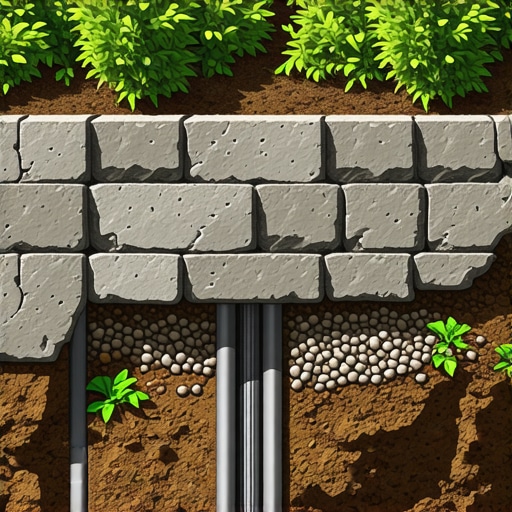
Successful commercial masonry maintenance starts with the ‘Drainage Trinity.’ First, you need clean, angular #57 stone—not rounded pea gravel that rolls like ball bearings, but stone with enough ‘tooth’ to lock together while maintaining 40% void space for water travel. Second, you need a non-woven geotextile fabric. This isn’t your garden-variety weed barrier. This fabric prevents the ‘fines’ (silt and clay) from migrating into your stone and clogging the system, a common cause for failing retaining wall repair calls. Third, the perforated pipe must be sloped to daylight. I’ve seen ‘pros’ lay pipe level, which just creates a long, underground mosquito pond. We also integrate masonry birdsmouth cuts at the coping level to ensure water sheds away from the wall face rather than dripping down and saturating the mortar joints.
“The design of a masonry retaining wall must provide for the dissipation of water pressure through the use of back-drainage and weep holes.” – ASTM C90 Standards for Loadbearing Concrete Masonry Units
Micro-Zooming into the Chemistry of Mortar and Suction
When we perform historic brickwork repointing, we aren’t just slapping mud in a gap. We are matching the ‘modulus of elasticity.’ If you use a high-strength Portland cement on a 19th-century soft brick, the brick will lose. The mortar must be the sacrificial lamb. In brick patio restoration, we often see ‘flash setting’ where the dry brick sucks the moisture out of the mortar before the hydration of the cement can complete. This leaves a ‘burned’ joint that crumbles under a fingernail. To prevent this, we ‘pre-hydrate’ the masonry, ensuring the suction is controlled. This same level of care is required for fire-rated masonry installation, where the material science must withstand extreme thermal gradients without spalling. For high-end aesthetics, we might even look at green roofing masonry integration, which requires a complex understanding of how plant-retained moisture interacts with the masonry’s alkalinity.
The Restoration Reality: From Cleaning to Structural Stability
Before you even think about masonry cleaning to remove the efflorescence—those white, salty stains that scream ‘I have a water problem’—you must fix the source. Cleaning a wall that still has active leaks is like painting a sinking ship. Once the drainage is fixed, we use low-pressure steam and specific detergents to lift the nitrates out of the stone’s pores. For walls that have already shifted, foundation slab jacking using high-density polyurethane can sometimes lift a footer back to level, but if the internal steel is ‘honeycombing’ or rusted to dust, it’s a teardown. Don’t be fooled by a ‘slicker’ tool hiding a cold joint; structural integrity is found in the ‘hawk’ of a mason who knows how to pack a joint tight. Whether it’s a simple crumbling mortar joint repair or a massive commercial masonry maintenance contract, the rules of gravity and water never change. You either control the water, or the water will control you.