
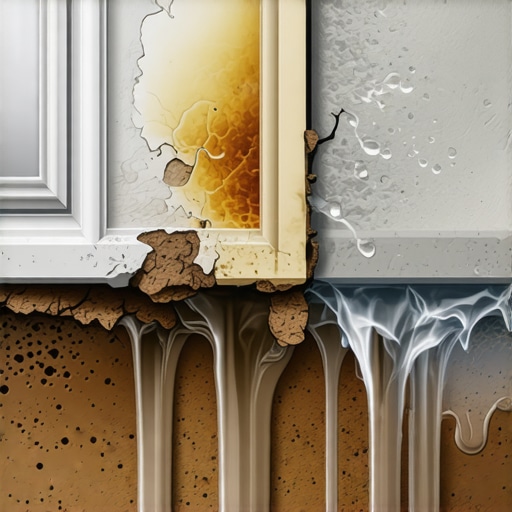
The Anatomy of a Failing Foundation
I remember a forensic scene in a 1920s bungalow where the homeowner pointed to a faint, white powdery haze on the interior block wall. She thought it was just dust from a recent renovation. I pulled my borescope from my kit and fed it through a small weep hole in the concrete block foundation repair site. What I saw on the monitor wasn’t just dust; it was a structural graveyard. The interior of the CMU cores was packed with wet silt, and the horizontal ladder reinforcement had rusted into a orange, flaky ghost of its former self. The wall wasn’t just ‘damp’—it was dissolving from the inside out. This is the reality of hydrostatic pressure, and if you think a coat of ‘waterproof’ paint is the cure, you are playing a dangerous game with gravity.
The Physics of Hydrostatic Pressure and Soil Heaving
To understand why moisture ruins your foundation, you have to understand the weight of the earth. When it rains, the soil surrounding your home acts like a giant sponge. Depending on the clay content, that soil expands. But it’s the water itself that does the heavy lifting. Water weighs roughly 62.4 pounds per cubic foot. When the ground is saturated, that ‘hydraulic head’ exerts massive lateral pressure against your walls. If you have a wall that is ten feet deep and forty feet long, you are looking at tens of thousands of pounds of force pushing inward. This is when we see the classic ‘stair-step’ cracks in the mortar joints or, more dangerously, a horizontal fracture midway up the wall where the block is literally being sheared. Using retaining wall reinforcement techniques in a residential foundation context isn’t overkill; it’s often the only way to counteract the sheer tonnage of a saturated hillside.
“Water penetration is the single greatest threat to masonry durability. Its presence within a masonry wall can lead to efflorescence, spalling, and the corrosion of embedded metals.” – BIA Technical Note 7
The Chemistry of Spalling and Carbonation
In the North, we deal with the freeze-thaw cycle, which is a master class in molecular destruction. When water enters the ‘pore structure’ of a brick or block, it settles into the microscopic voids. When the temperature drops, that water expands by 9%. It sounds small, but that expansion generates internal pressures that can exceed the tensile strength of the masonry itself. This is why you see the faces of bricks popping off—a process we call ‘spalling.’ If someone has applied a cheap stone veneer over brick without a proper drainage plane, they’ve effectively built a death trap for the original masonry. The moisture gets trapped behind the lick-and-stick stone, freezes, and rips the face off the structural brick behind it. We see similar issues in commercial smokestack repair, where the thermal gradient between the hot interior and freezing exterior creates a ‘dew point’ inside the wall itself, leading to rapid degradation.
The Sacrificial Joint: Why Your ‘Mud’ Matters
I see it every week: a well-meaning handyman grabs a bag of high-strength Portland cement to ‘fix’ an old foundation. He ‘butters’ the joints with mortar that is harder than the original units. This is a cardinal sin of brick wall restoration. In a proper masonry system, the mortar should be the ‘sacrificial lamb.’ It needs to be softer and more vapor-permeable than the brick or block. If the wall moves—and it will move—the mortar should develop hairline cracks, not the brick. When you use a tuckpointing machine services provider, you must ensure they are matching the existing mortar’s lime-to-cement ratio. If you’re working on a pre-1940s home, you’re likely looking at Type O or even a pure lime putty. Using a hard Type S mortar on soft, historic brick is like putting a steel plate between two pieces of glass and hitting it with a hammer.
The Scam of the ‘Surface Fix’
Be wary of contractors offering metallic masonry finishes or thick, elastomeric coatings as a ‘solution’ to foundation moisture. These are often ‘Band-Aids’ that hide the symptoms while the disease gets worse. These coatings are often non-breathable. They trap water vapor inside the wall. Because of the vapor pressure gradient, that moisture will eventually try to escape. If it can’t evaporate through the surface, it will build up until it causes ‘subflorescence’—where salt crystals grow behind the coating, eventually blowing the finish off in large chunks. True masonry repair services involve managing the water before it ever hits the wall. This means looking at your ‘angle of repose,’ ensuring your gutters aren’t dumping five hundred gallons of water into a single corner, and checking that your brick infill panel repair includes proper weeps.
“Mortar should be designed to be weaker than the masonry units so that any cracks that occur will be in the mortar joints where they can be easily repaired.” – ASTM C270 Standard Specification for Mortar
The Forensic Inspector’s Fix: Cure vs. Band-Aid
When I’m called to a job where the foundation is ‘weeping’ or ‘honeycombing’—that’s where the aggregate is exposed because the cement paste has washed away—I look for the ‘Cure.’ The ‘Band-Aid’ is an epoxy injection or a bit of masonry staining to hide the water damage. The ‘Cure’ is excavation. You have to get down to the footing, clean the wall, and apply a high-quality bituthene membrane or a fluid-applied rubberized coating. Then, you install a proper drainage mat and a perforated pipe in a gravel bed (a French drain). We also look at the ‘Slicker’—the tool used to finish the joint. A properly ‘struck’ joint, like a concave or V-joint, actually compacts the ‘mud’ and creates a surface that sheds water. A ‘raked’ joint, while popular for modern aesthetics, creates a shelf where water can sit and soak into the wall.
When to Panic: Identifying Structural Instability
Not every crack is a death sentence, but some are warnings. If you see a crack where you can fit a nickel, it’s time to call an expert. If you see ‘Soldier Courses’ (bricks stood on end) that are leaning outward, you have a rotation problem. If you notice horizontal cracking near the frost line, you have a frost-heave issue. We often see this in concrete block foundation repair where the top two courses are literally being shoved inward by the freezing soil. In these cases, we might use carbon fiber straps or even helical piers to stabilize the structure. The bottom line? Masonry is a living, breathing system of physics and chemistry. Treat it like a solid, unchanging rock, and it will prove you wrong in the most expensive way possible.