
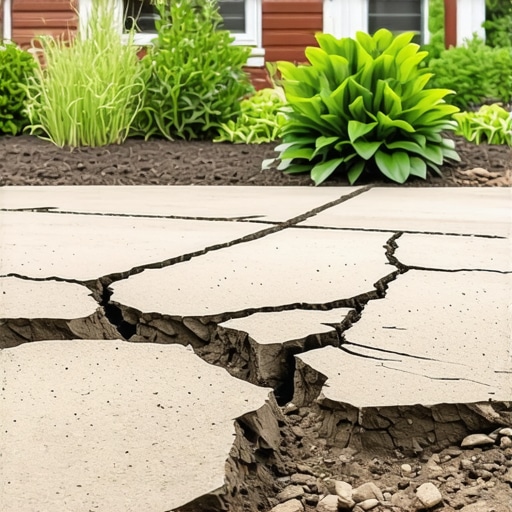
The Unseen War Beneath Your Feet
When you walk into a basement and smell that heavy, mineral scent of damp earth and calcified concrete, you aren’t just smelling a house; you’re smelling a battle. I’ve spent forty years reading the language of cracks, and I can tell you right now: the ground doesn’t care about your mortgage. It’s a living, breathing, expanding mass of silicate and moisture. When a slab starts to heave—lifting up in the center or bowing like a ship’s hull—most folks think the house is just ‘settling.’ That’s a layman’s lie. Houses don’t settle up. They heave because the physics of the soil has overcome the dead load of the structure. I remember a forensic scene on a property where the owner pointed to a hairline fracture in the corner of a slab-on-grade garage. To him, it was a cosmetic nuisance. But when I inserted the borescope through a relief hole, I found the internal steel reinforcement wasn’t just rusted; it had undergone such severe oxidation that it had expanded to three times its original thickness, acting like a wedge that was literally blowing the concrete apart from the inside out. The soil beneath had turned into a hydraulic piston of wet clay, and the structure was losing the fight.
The Geophysics of the Frost Lens
In the northern climates, we deal with the brutal reality of the freeze-thaw cycle. This isn’t just about water getting cold. This is about adfreeze and ice lenses. When moisture in the soil freezes, it doesn’t just turn into a solid block. It migrates toward the freezing front, forming lenses of pure ice that can exert pressures exceeding 50,000 pounds per square foot. If your foundation isn’t protected by masonry waterproofing solutions or proper drainage, that ice lens is going to find the path of least resistance: your slab.
“Frost action in soils is the result of the formation of ice lenses, which can cause significant upward displacement of foundations if the soil is frost-susceptible and water is available.” – U.S. Army Corps of Engineers Technical Manual
This upward pressure is often exacerbated by honeycombing in the original concrete pour—those tiny voids where the ‘mud’ didn’t consolidate around the aggregate. Water hitches a ride into those voids, freezes, and pops the concrete like a cheap walnut.
The Connection Between Heaving and Your Facade
A foundation heave is never a localized event. It’s a chain reaction. When the slab moves, it puts tension on the brick veneer installation. Because brick is a rigid material, it cannot bend. It shears. This is where you see the classic stair-step cracking through the mortar joints. I’ve seen commercial masonry facade maintenance programs that try to hide these cracks with tile grouts on masonry or cheap caulk, but that’s like putting a band-aid on a gunshot wound. You need to understand the ‘tooth’ of the masonry. If the foundation is moving, the facade is screaming. This movement often leads to the need for tuckpointing tools for DIY enthusiasts who think they can just ‘butter’ the joints back together. But if you don’t address the hydrostatic pressure in the soil, you’ll be doing that same job every two years. Proper tuckpointing cost estimation must account for the underlying structural stability; otherwise, you’re just throwing good mud after bad.
The Role of Capillary Suction and Moisture Barriers
One of the most overlooked aspects of slab heaving is the chemistry of the soil itself. Silt and clay are the enemies of a stable slab. They have high capillary suction, meaning they draw water up from the water table like a wick. When that water meets a warm basement floor, it creates a vapor pressure differential. If your slab was poured without a high-density vapor barrier, that moisture is constantly trying to push through the concrete. This leads to efflorescence—that white, salty powder you see on the surface—and eventually, it degrades the masonry cleaning efforts of any commercial owner.
“Water penetration is the single greatest threat to masonry durability.” – BIA Technical Note 7
When we talk about commercial masonry maintenance, we aren’t just talking about washing the windows. We’re talking about managing the moisture flow from the footer to the chimney heat shield installation at the very top. If the bottom is moving, the top is swaying.
How to Stop the Heave: The Forensic Fix
Stopping a heave requires more than just a thicker slab. It requires a total redesign of the soil-structure interface. First, you have to kill the water source. This means masonry waterproofing solutions that go beyond a simple tar coating. We’re talking dimple boards and perforated drainage tiles buried in washed stone. Second, you have to address the ‘flash setting’ of any repairs. If you’re doing facade cleaning or repointing while the slab is still in motion, the new mortar will ‘burn’—it dries too fast because the dry bricks suck the moisture out of the mix before it can hydrate the cement particles. You have to wet the ‘tooth’ of the old masonry before applying new mud. For the slab itself, sometimes the only answer is underpinning with helical piers to bypass the active soil zone entirely. This is why tuckpointing cost estimation is so varied; you aren’t just paying for the mortar, you’re paying for the forensic knowledge to know why the mortar fell out in the first place. Whether it’s a brick veneer installation on a residential home or commercial masonry facade maintenance on a high-rise, the physics remains the same: Respect the water, or the water will disrespect your work.