
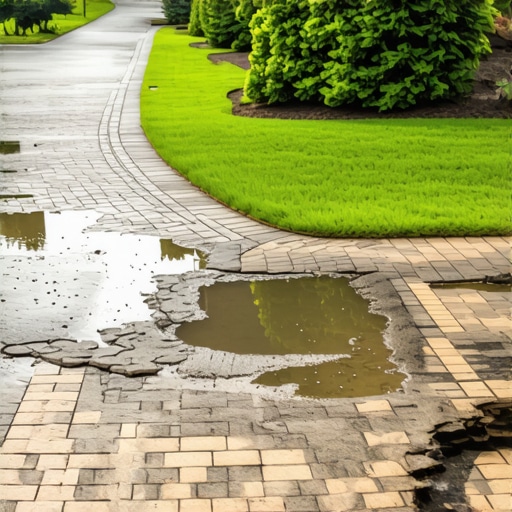
The Sinking Truth Behind Your Driveway’s Wavy Profile
I stood looking at a $70,000 drive in the hills of Virginia that looked more like a topographical map of the Appalachians than a flat surface. The homeowner was distraught; every time a heavy storm rolled through, the individual units didn’t just get wet—they migrated. The contractor had made it look beautiful for the photos, but he forgot the cardinal rule of any load-bearing assembly: the earth is alive, and water is the ultimate lubricator of failure. When I performed the initial masonry damage assessment, it wasn’t the pavers that were the problem. It was the two inches of stone dust sitting on uncompacted clay that turned into a slurry the moment the sky opened up.
The Physics of the ‘Pump’ and Pore Pressure
To understand why your driveway is failing, you have to look past the surface. When heavy rain hits an improperly prepared paver system, it doesn’t just run off; it infiltrates. If the sub-base isn’t engineered for drainage, that water sits in the voids between the stones. As your two-ton SUV rolls over those pavers, it creates what we call ‘pore pressure.’ You are effectively hydraulic-jacking your own driveway. The weight of the vehicle forces the water downward, but since the water has nowhere to go, it pushes the fines—those tiny particles of sand and stone—out from under the pavers. This is the ‘pumping’ effect. Over time, you’re left with voids, and where there are voids, there is settlement.
“The stability of any masonry system is entirely dependent upon the management of moisture and the structural integrity of its foundation layers.” – ASTM D1557 Standard Test Methods for Laboratory Compaction Characteristics of Soil
The Anatomy of a Failure: Base vs. Sub-Base
In my thirty years of ‘buttering’ joints and ‘striking’ lines, I’ve seen enough brick patio restoration jobs to know that most guys skip the prep because it’s the part you can’t see. A proper driveway requires a graduated filter system. You start with the subgrade—the raw dirt. If you’re in a heavy clay region, that clay holds water like a sponge. When it gets saturated, its shear strength drops to near zero. This is where retaining wall geogrid installation logic comes into play even on flat ground. Sometimes you need a biaxial grid to bridge the soft spots and keep the gravel from sinking into the muck.
Then comes the ‘base.’ We’re not talking about a couple of inches of ‘all-in’ from the local yard. We’re talking about 6 to 10 inches of crushed 21A or 57 stone, compacted in ‘lifts’ of no more than four inches at a time. If you don’t ‘vibe’ it down with a heavy plate compactor, you’re just laying stones on a pile of air. Micro-zooming into the chemistry, when we talk about compaction, we are trying to achieve the ‘Proctor density.’ This is the point where the stones are so tightly wedged together that their internal friction exceeds any downward force from a vehicle. Without this, the first big rain acts as a lubricant, allowing those stones to slide past each other, leading to those ugly ruts.
Why Modern ‘Lick-and-Stick’ Mentalities Fail
We live in an era of shortcuts. I see it in commercial masonry facade maintenance and I see it in residential driveways. The ‘handyman special’ involves throwing down some plastic edging and a bag of leveling sand. But sand is not a structural material when it’s wet. It’s a fluid. For a driveway that lasts a century, you need sustainable block cutting techniques and a base that breathes. Mortarless masonry systems depend entirely on the ‘interlock.’ That interlock is achieved by vibrating sand into the joints, which creates a friction bond. If the base moves even a fraction of an inch, that bond is broken, and the whole system becomes a collection of loose rocks.
The Restoration Reality: Fixing the Sinking Ship
When I’m called in for a brick column repair or a failing driveway, the first thing I check is the ‘tooth’ of the material. Is the paver actually worn, or is it just displaced? Most of the time, the material is fine; the engineering is what failed. For historic mortar analysis in older walkways, we often find that the ‘old-timers’ used a mixture of lime and cinders which actually allowed for more movement and better drainage than modern Portland-based ‘mud.’ In modern restorations, we often have to excavate the entire ‘cold joint’ area and start from the dirt up.
“Water penetration is the single greatest threat to masonry durability, specifically when it results in the saturation of the bedding layer.” – BIA Technical Note 14 on Paving Systems
Advanced Solutions: From Geogrids to Robotic Masonry Repair
We are entering a new age where robotic masonry repair is becoming a reality for large-scale commercial facades, but for your driveway, the ‘robot’ is still a man with a hawk and a trowel who knows how to read the land. If you’re building an outdoor kitchen masonry build or a heavy-duty drive, you have to consider the ‘hydrostatic pressure’ building up behind your edges. We now use non-woven geotextiles to separate the soil from the stone. This prevents ‘migration,’ which is a fancy word for your expensive pavers sinking into the mud. It’s about creating a ‘bridge’ that spans the soft spots in the earth.
The ‘Leftover Material’ Scam
Beware the contractor who knocks on your door saying he has ‘leftover material’ from a nearby commercial masonry facade maintenance job. These guys are the ‘Asphalt Gypsies’ of the masonry world. They’ll slap down some pavers, throw a little ‘mud’ in the joints to make it look ‘slick,’ and be gone before the first thunderstorm. A real mason doesn’t have ‘leftover’ base material because he knows exactly how many tons he needs to hit his compaction depth. If they aren’t talking about ‘modified 2A’ or ‘geotextile separation layers,’ they aren’t building a driveway; they’re building a future headache.
Final Verdict: Do It Once or Do It Twice
A paver driveway shouldn’t move. If it’s shifting after a rain, the ‘suction’ of the soil is pulling your investment into the ground. Whether you’re looking at brick column repair or a full driveway overhaul, remember that the surface is just the ‘skin.’ The ‘bone’ is the stone underneath. Invest in the base, manage the water, and your masonry will outlive you. Cut corners on the drainage, and you’ll be calling someone like me to perform a forensic autopsy on your bank account. Do it right the first time, or don’t do it at all. That’s the code of the craft.