
The $80,000 Landslide: A Forensic Lesson in Hydrostatic Pressure
I remember standing on a steep hillside in the dead of November, the air tasting like wet earth and cold iron. Below me lay what used to be a premium modular masonry construction project—an eighty-thousand-dollar tiered retaining wall system that had, over the course of one rainy weekend, decided to relocate itself thirty feet down-slope into the client’s swimming pool. The homeowner was white-faced, pointing at the shattered blocks. The contractor had used the finest metallic brick colors application for the accents and high-strength geogrid, but he’d made the fatal mistake of an amateur: he treated the wall like a dam rather than a filter. He forgot the weep holes. When I stepped into the mud to inspect the wreckage, the cause was clear. The soil behind the wall was a soup of saturated clay, and without a way for that water to escape, the hydrostatic pressure had simply pushed the entire structure off its footing as if it were made of cardboard. It wasn’t a failure of the stone; it was a failure of physics.
The Invisible Enemy: Understanding Hydrostatic Force
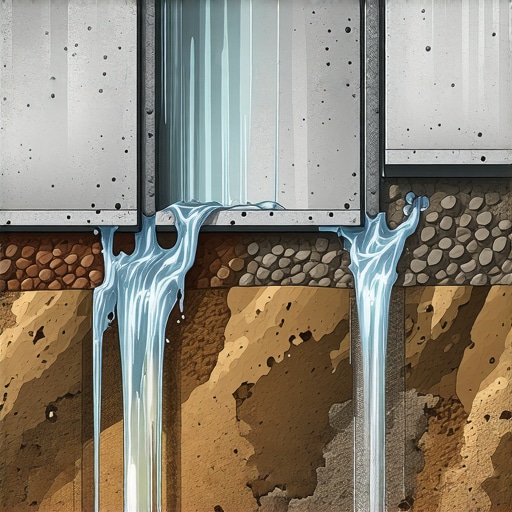
In the world of professional retaining wall installation, we don’t just fight gravity; we fight the weight of water. Soil is heavy, but saturated soil is a monster. When rain soaks into the backfill, the water fills the voids between particles, increasing the lateral earth pressure exponentially. If that water has nowhere to go, it exerts a force known as hydrostatic pressure. To put this in perspective, water weighs approximately 62.4 pounds per cubic foot. In a twenty-foot wall, that pressure builds at the base like a hydraulic jack. This is why retaining wall weep hole cleaning isn’t just a maintenance chore—it’s a structural necessity. Without those small apertures at the base, the wall is doomed from the moment the first storm cloud gathers.
“Adequate drainage is the most critical factor in the design and long-term performance of any masonry retaining wall. Without it, the structural integrity is compromised by forces far exceeding the weight of the masonry units.” – BIA Technical Note 18A
The Anatomy of a Functional Drainage System
A weep hole is only the exit point; the real work happens behind the face of the wall. When we perform stone wall repair or new builds, we create a vertical ‘chimney’ of clean, angular gravel directly behind the masonry. This gravel acts as a high-speed highway for water, directing it downward toward the weep holes. If you’re looking at a wall and don’t see 2-inch to 4-inch openings every few feet along the bottom course, you’re looking at a ticking time bomb. In northern climates where the freeze-thaw cycle reigns supreme, this is even more dangerous. Water trapped behind a wall expands by 9% when it turns to ice. That expansion can snap a 12-inch thick concrete block like a dry twig, leading to retaining wall block replacement jobs that could have been avoided with five dollars’ worth of PVC pipe.
Modular Masonry and the Modern Aesthetic
Modern modular masonry construction has come a long way from the gray, drab blocks of the 1970s. Today, we deal with sophisticated metallic brick colors application and textures that mimic natural slate or hand-cut granite. But even the most beautiful soldier course or brick quoin repair won’t save a wall that’s leaning at a five-degree angle because the base is waterlogged. I’ve seen stunning properties where green roofing masonry integration was used to manage runoff, yet the retaining walls were failing because the installer didn’t understand the ‘tooth’ of the soil. When you combine high-end aesthetics with structural forensic needs, you realize that the ‘mud’ (mortar) and the stone are only as good as the drainage plan.
The Forensic Scene: Signs of Impending Failure
How do you know if your wall is holding its breath? Look for the salt. Efflorescence—that white, powdery staining on the face of the brick—is the wall’s way of crying. It means water is migrating through the masonry, dissolving salts in the mortar and depositing them on the surface. If you see this, your drainage is likely clogged, or your chimney interior parging is failing to keep moisture out of the core. More concerning is ‘honeycombing’ in the concrete or horizontal cracks. If the wall is bowing, you might be looking at foundation slab jacking to stabilize the ground around it, or worse, a total tear-out. I always tell clients: if the weep holes are dry after a heavy rain, but the wall is damp, you have a major problem hidden in the backfill.
“Weep holes shall be provided in the outside wythe of exterior masonry walls at a maximum spacing of 33 inches on center. Weep holes shall not be less than 3/16 inch in diameter.” – ASTM C270 / International Building Code
The Physics of the North: Freeze-Thaw Torture
In regions like Chicago or New York, the soil doesn’t just sit there; it heaves. When you have a retaining wall installation in these zones, the moisture management must be surgical. If water stays in the units, the ‘spalling’ begins—the face of the brick literally pops off because the internal pressure of the ice is greater than the tensile strength of the fired clay. This is why we use air-entrained concrete for footings and soft lime-based mortars for stone wall repair in historic contexts. A hard Portland-heavy mix will trap moisture; a soft, breathable ‘mud’ allows the wall to exhale. It’s the difference between a structure that lasts twenty years and one that lasts two hundred.
Maintenance and Restoration: More Than Just Buttering Joints
Restoration isn’t just about ‘buttering’ a joint with a fresh layer of mortar and calling it a day. It’s a tactile process. It involves using a slicker to ensure the joint is compacted and ‘struck’ correctly to shed water. When we approach retaining wall block replacement, we check the ‘suction’ of the surrounding units. If the original wall was built with dry-pressed blocks, the new units must match that porosity. For homeowners, retaining wall weep hole cleaning should be an annual ritual. Take a piece of stiff wire or a small bottle brush and clear out any silt, nests, or debris. If water starts pouring out once you clear the blockage, you’ve just saved yourself a five-figure repair bill.
Conclusion: Do It Once or Do It Twice
I’ve spent thirty years watching the earth try to reclaim the structures humans build. The most successful projects aren’t the ones with the flashiest metallic brick colors application; they are the ones that respect the silent power of water. Whether you are looking into foundation slab jacking for a sinking patio or a complex green roofing masonry integration, the principle remains the same: give the water a path, or it will make its own. Don’t trust a ‘handyman special’ with your structural safety. A real mason knows that the beauty of the wall is in the craft, but the life of the wall is in the drainage. If your contractor doesn’t talk about hydrostatic pressure within the first ten minutes of a consultation, find someone who does. Your foundation—and your wallet—will thank you.