
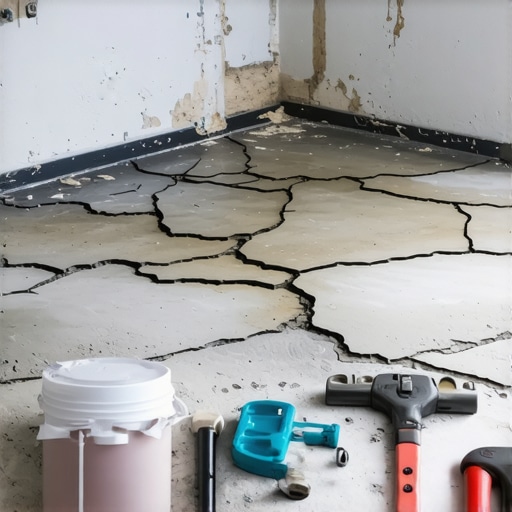
The homeowner thought it was just some dusty road salt that had tracked in from the winter. But when I knelt down in that damp, dimly lit cellar and dragged a masonry hammer across the floor, the surface didn’t just scratch—it disintegrated. Pieces of the slab flaked off like layers of old, dry skin, revealing a soft, sandy interior. I put my digital scope into a hairline fracture near the floor drain and what I saw confirmed the worst: the structural integrity was being eaten from the inside out by poor chemical hydration and decades of hydrostatic pressure. This wasn’t a job for a bucket of hardware store patch-kit; this was a forensic failure of the concrete matrix itself.
The Anatomy of an Exfoliating Slab: Why Concrete Spalls
When your basement floor starts flaking—a process we call spalling or scaling—you aren’t just looking at a cosmetic blemish. You are witnessing the physical divorce of the concrete’s paste from its aggregate. In the northern freeze-thaw zones, this is often the result of water entering the microscopic capillaries of the concrete. Water is one of the few substances on earth that expands when it freezes—roughly 9% in volume. If that water is trapped within the top 1/8th inch of your slab, that 9% expansion creates internal tensile pressures that exceed the strength of the mud. The surface simply pops off.
But in a basement, there is a more insidious culprit: Laitance. This is that weak, milky layer of cement and sand that rises to the top if the original finishers added too much water to the concrete pump masonry mixes to make it easier to spread. They were looking for a ‘slick’ finish, but they ended up ‘burning’ the floor. By over-troweling a wet mix, they drew the fines to the surface and left the structural heavy-lifters—the coarse aggregate—sinking to the bottom. What you’re left with is a surface that has the structural integrity of a sugar cube.
“Scaling of concrete surfaces is often caused by the pressure from the expansion of water during freezing, but it is significantly exacerbated by the use of de-icing chemicals and poor finishing practices that create a weak surface layer.” – Portland Cement Association (PCA) Manual
The Forensic Masonry Damage Assessment
Before you even think about retaining wall reinforcement or slapping a new coat of sustainable masonry materials over the mess, you need a masonry damage assessment. I start by ‘sounding’ the slab. I take a heavy steel chain or a solid masonry bar and drag it across the floor. A healthy slab rings with a high-pitched ‘ping.’ A failing, delaminated slab sounds like a hollow drum. If the ‘thud’ is localized, we can talk about a repair. If the whole floor sounds like a cardboard box, we’re looking at a full-depth crisis.
We also look at the ‘batter.’ While usually discussed in retaining wall batter correction, the slope and heave of a basement floor tell a story. If the floor is heaving, it’s often hydrostatic pressure—the weight of the groundwater pushing upward. If you don’t solve the drainage issue outside, any resurfacer you ‘butter’ onto that floor will be blown off by the same pressure within two seasons.
The Professional Protocol for Resurfacing
To fix a flaking floor right, you have to move past the ‘handyman’ mindset. You don’t just sweep it; you have to mechanically prep the substrate to a Concrete Surface Profile (CSP) of at least 3. This means grinding the floor with diamond-segmented heads until you’ve stripped away every molecule of that weak laitance. You need to get down to the ‘tooth’ of the concrete—the raw, open pores where a new bond can actually take hold.
Once the floor is ground, we use a digital twin masonry project model if we’re dealing with complex structural shifts, but for a standard basement, we move straight to chemical bonding. We aren’t just using Elmer’s glue here. We’re talking about epoxy-modified cementitious bond coats. You ‘butter’ the floor with a slurry that undergoes a covalent bond with the old silica. Then, we apply a high-performance overlay, often reinforced with micro-fibers to prevent plastic shrinkage cracking.
Expanding the Scope: Beyond the Floor
Often, a flaking basement floor is just one symptom of a house that is losing its fight with the elements. I’ve seen chimneys where the chimney flue liner installation was botched, leading to acidic condensation that eats the mortar from the inside out, much like the salts eat your floor. Or spalled concrete steps repair jobs where the homeowner used rock salt for twenty years, effectively turning their front porch into a crumbling reef. In every case, the physics is the same: the material was too porous, and the environment was too harsh.
“The durability of masonry is directly proportional to its ability to manage moisture through proper pore structure and the use of sacrificial mortars.” – ASTM C270 Standard Specification
When we’re on-site, we also look at the exterior. If the retaining wall capstone replacement wasn’t done correctly, water is shedding right into the foundation. If the wall is leaning, we might need retaining wall reinforcement using helical anchors or flush pointing services to seal the brickwork. It’s a holistic system. You can’t fix the floor while the walls are weeping.
The Hard Truth About DIY Patches
I’ve seen guys try to use ‘self-leveling’ compounds from the big-box stores. They pour it out, it looks like a mirror for a week, and then it starts to crack. Why? Because they didn’t account for the vapor transmission. Moisture is constantly moving through your basement slab. If you seal it with a non-breathable ‘lick-and-stick’ product, that vapor pressure builds up until it literally hydro-blasts the new coating off the floor. We use breathable, polymer-modified mortars that allow the slab to ‘breathe’ while still providing a hard-as-nails finish that can handle a soldier course of heavy shelving or equipment.
Final Inspection
Resurfacing a basement floor isn’t about making it pretty—it’s about restoring a structural wear surface. Whether you’re dealing with spalled concrete steps repair or a 2,000-square-foot industrial basement, the rules of the hawk and the slicker don’t change. You respect the chemistry, you prep the substrate like your life depends on it, and you never, ever trust a mix that’s too wet. Do it once, or do it twice. The choice is yours, but the concrete never lies.