
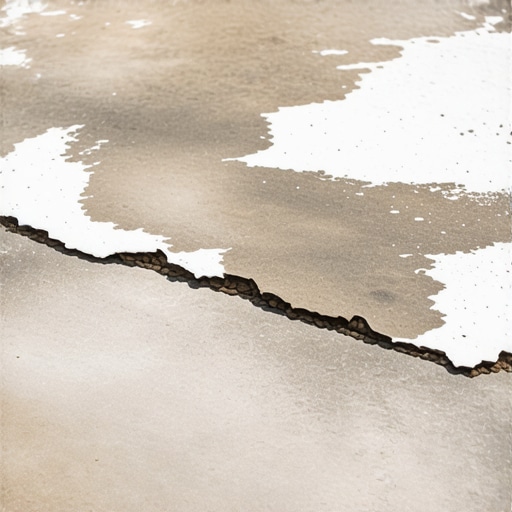
The Autopsy of a Failing Slab
The homeowner called me out to look at a six-month-old patio that he said was ‘shedding.’ He thought it was just construction dust or maybe some leftover dirt from the landscapers. But as soon as I knelt down and ran my thumb across the surface, the truth flaked off in brittle, grey wafers. I pulled out my 10x loop and looked at the cross-section. Beneath that thin, dusty ‘cream’ layer, the aggregate was exposed and raw. It wasn’t just dirty; the concrete was literally unzipping itself at the molecular level. This wasn’t a freak accident of nature. This was a crime of chemistry committed by a contractor who cared more about his clock-out time than the hydration of the slab.
The Physics of the ‘Friday Afternoon’ Pour
When we talk about scaling—or spalling—we are talking about the failure of the surface mortar. Concrete isn’t just a grey rock; it is a complex chemical matrix of Calcium Silicate Hydrate (CSH) crystals. To understand why your patio is peeling like a bad sunburn, we have to zoom into the capillary pores. In a perfect world, the water-to-cement ratio is balanced. But often, in the rush of a concrete pump masonry mixes delivery, installers add extra water to make the ‘mud’ flow easier. This excess water has to go somewhere. It migrates to the top, creating ‘bleed water.’ If a finisher ‘butters’ the surface with a steel trowel while that bleed water is still sitting there, they trap the moisture just below the surface. This creates a weak, porous layer known as laitance.
“Scaling of concrete surfaces is primarily caused by the pressure of expanding ice crystals within the pores of the concrete matrix, exacerbated by the use of de-icing chemicals.” – ASTM C672 Standard Commentary
The Freeze-Thaw War
In the frost-belt, water is a structural assassin. When water gets trapped in those microscopic voids created by excess bleed water, it waits. When the temperature drops, that water expands by approximately 9% in volume. This isn’t just a gentle push; it is an internal explosion. Because the surface layer was over-finished and the ‘cream’ is too brittle, the pressure has no relief. It pops the face of the concrete right off. This is why concrete pump masonry mixes must be air-entrained. We are talking about billions of microscopic bubbles—microns in diameter—that act as tiny pressure relief valves for expanding ice. If your contractor didn’t specify an air-entrainment of 5% to 7% for your outdoor slab, they didn’t build you a patio; they built you a ticking time bomb.
The Myth of the ‘Lick-and-Stick’ Solution
I see it every week: a guy with a bucket of tile grouts on masonry trying to ‘patch’ a scaling patio. It’s a waste of time and money. You can’t stick new mud to a dead surface. The bond will fail because the substrate itself is chalky. If you are dealing with structural issues alongside your patio, like chimney structural repair or brick arch restoration, you know that the foundation is everything. You cannot fix a scaling slab by painting over it. You have to remove the ‘dead’ material. This often involves mechanical grinding or shot-blasting until you hit sound, hard aggregate. Only then can you consider a high-strength polymer-modified overlay.
Protecting the Matrix: Porous Stone Sealers
Once you have a sound surface, the goal is to keep the water out. This is where porous stone sealers come into play. But don’t grab the cheap ‘wet look’ acrylic from the big-box store. Those are just films that sit on top and eventually peel. You need a silane-siloxane penetrating sealer. These molecules are small enough to enter the capillary pores and chemically bond to the interior walls, turning the concrete’s ‘thirst’ into water-repellency. It’s the difference between wearing a plastic poncho and treating your boots with wax. For those managing complex BIM masonry projects, we specify these sealers at the design phase because we know that ‘breathability’ is the only way to ensure longevity. A slab must be able to exhale vapor while refusing to inhale liquid water.
“Proper drainage and the maintenance of a low water-cement ratio are the first lines of defense against masonry deterioration.” – BIA Technical Note 1
The Forensic Inspection: Beyond the Slab
Sometimes the patio isn’t the only thing failing. I’ve seen patios scale because the retaining wall batter correction was ignored, leading to hydrostatic pressure pushing water underneath the slab from the uphill side. This constant saturation keeps the concrete at a high degree of moisture, making it 100% susceptible to freeze-thaw damage. If you have a chimney nearby that needs chimney repair services or chimney interior parging, the moisture intrusion from a failing crown or faulty flashing can also migrate down through the masonry and saturate the patio base. It’s all connected. You have to look at the ‘envelope’ of the property. Is the facade cleaning being done with high-pressure water that’s saturating the brickwork? Every drop of water you introduce to the system has to have an exit strategy.
The Professional’s Checklist for a New Pour
If you are tearing out the old flaky mess and starting over, you have to be the foreman of your own backyard. First, demand a low water-cement ratio (0.45 or lower). Second, ensure they aren’t using a steel trowel if it’s an outdoor air-entrained slab; a wood or magnesium float is what you want to keep those pores open. Third, watch for ‘honeycombing’ at the edges. If you see voids where the aggregate didn’t settle, your contractor didn’t vibrate the edges properly. Fourth, if they are laying a soldier course of bricks around the edge, make sure they aren’t just ‘buttering’ the brick and slapping it down. They need a full bed of Type M mortar and proper drainage behind the edge. Don’t let them tell you that a little scaling is ‘normal.’ It’s a sign of a failed process. Do it once, do it right, or you’ll be calling me back in two years to write another autopsy report.