
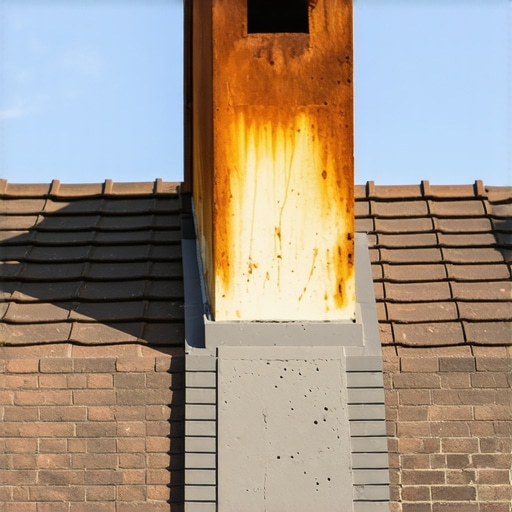
The Forensic Scene: When Copper Hides a Corpse
The homeowner was adamant. She had spent four thousand dollars on custom lead-coated copper flashing just three seasons ago, yet the ceiling in the master bedroom looked like a topographical map of a swamp. I climbed the scaffolding, my boots crunching on the loose grit of failing shingles, and pulled out my digital borescope. From the outside, the metalwork was a masterpiece, but when I threaded the lens through a small gap in the mortar, I saw the truth: the inner structural steel was rusted to a fine orange dust, and the back-up masonry was so saturated it had the consistency of wet oatmeal. This wasn’t a flashing failure in the traditional sense; it was a systemic collapse of the masonry’s ability to manage moisture. Most guys will tell you it’s a caulking issue. They’re wrong. It’s a physics issue.
Differential Thermal Expansion: The Metal-to-Masonry War
The core of the problem lies in the violent disagreement between materials. A chimney is an island of masonry exposed to 360 degrees of environmental punishment. In the winter, the interior of the flue might reach four hundred degrees while the exterior face is lashed by sub-zero winds. This creates a massive thermal gradient. When you wrap that chimney in metal flashing, you are introducing a material with a wildly different coefficient of expansion. Metal moves fast and far; brick moves slow and steady. If your structural masonry inspection doesn’t account for the way these two materials dance, the bond will break every single time.
“Water penetration is the single greatest threat to masonry durability, specifically when trapped within the wall system by impermeable layers.” – BIA Technical Note 7
When the sun hits that copper, it expands, pulling away from the brick. If the mason used a cheap, high-modulus polyurethane sealant instead of a proper brickwork sealants application designed for high-movement joints, the sealant tears. This creates a microscopic ‘shelf’ where water sits. In Northern climates, that water undergoes the freeze-thaw cycle, expanding 9% in volume. That expansion acts like a slow-motion explosion, popping the faces off your bricks and turning your mortar into powder.
The Anatomy of the Mud: Why Your Mortar Matters
I’ve seen too many ‘restoration’ jobs where some guy with a bucket of Type S cement from a big-box store thinks he’s doing a favor by making the joints ‘strong.’ In chimney work, strength is your enemy. You need flexibility. Using high-Portland cement on a chimney built with older, softer bricks is a death sentence. The mortar must be the sacrificial lamb of the system. I always mix my ‘mud’ to be softer than the masonry units themselves. This is the ‘Sacrificial Principle.’ If the wall moves, the mortar should develop hairline cracks that can be easily repointed, rather than the brick itself shattering.
Proper brickwork pointing styles are not just about aesthetics. A ‘raked’ joint—where the mortar is recessed—is a water ledge. It’s an invitation for disaster. On a chimney, you want a concave joint or a weathered joint, struck with a slicker to pack the mud tight against the ‘tooth’ of the brick. This compaction creates a skin that resists water penetration while still allowing the masonry to breathe. If you don’t ‘butter’ the ends of your bricks correctly during a chimney rebuild services call, you’re leaving internal voids—honeycombing—where water will congregate and rot the structure from the inside out.
The Crown of Thorns: The Real Culprit
Often, the flashing is failing because the chimney crown is a disaster. The crown is the umbrella of your chimney. Most builders just slap a two-inch layer of mortar over the top and call it a day. That mortar shrinks, cracks, and allows water to pour down the center of the wall, bypassing the flashing entirely. A forensic chimney crown repair requires a cast-in-place concrete cap with a drip edge that overhangs the masonry by at least two inches. Without that drip edge, water runs down the face of the brick, finds the flashing’s top edge, and uses capillary action to ‘wick’ its way behind the metal. It’s not a leak; it’s a siphon.
“Mortar shall be specified by either proportion specifications or property specifications.” – ASTM C270 Standard
Modern Failure and 3D Printed Masonry Repairs
We are entering a strange era where 3D printed masonry repairs are being used to create custom-fit chimney caps and ornate decorative elements. While the precision is incredible, the material science often lags. These printed structures can be too dense, lacking the natural pore structure of traditional fired clay. This density prevents the ‘suction’ needed for a proper bond with the mud. Whether you are doing retaining wall block replacement at the base or rebuilds at the top, you have to respect the porosity of the material. If the brick doesn’t ‘suck’ the moisture from the mortar, you get a cold joint, and a cold joint is just a crack that hasn’t opened yet.
Foundation Waterproofing and the Chimney Base
Don’t overlook where the chimney meets the earth. I’ve seen chimneys that seem to be ‘leaking’ at the roofline, but the water is actually being pulled up from the ground through capillary rise. If the foundation waterproofing at the base of the chimney stack is compromised, the entire column acts like a giant wick. This is why masonry rescue after disaster often involves more than just roof work; it requires a holistic look at the vertical transit of moisture. Even the tile grouts on masonry hearths inside the house can show signs of this ‘rising damp’ long before the exterior flashing shows a visible gap.
The Master Mason’s Verdict
If your flashing is failing every three years, stop hiring roofers to fix a masonry problem. You need to address the hydration of the joints, the breathability of the brickwork sealants application, and the structural integrity of the soldier course at the top. Use a hawk and trowel to apply a lime-rich mix that can move with the seasons. Don’t let a handyman ‘lick-and-stick’ a solution onto a forensic structural failure. Do it once, do it right, or get used to the smell of damp drywall. Masonry isn’t just stacking stones; it’s managing the inevitable movement of the earth and the sky. “,”image”:{“imagePrompt”:”A gritty, close-up forensic photo of a weathered brick chimney showing a rusted metal flashing joint, with a master mason’s hand holding a borescope. The texture of the crumbling mortar and the ‘tooth’ of the old bricks are visible. Natural, harsh outdoor lighting.”,”imageTitle”:”Forensic Masonry Inspection of Chimney Flashing”,”imageAlt”:”A forensic view of failing masonry and rusted flashing on an old chimney stack.”},”categoryId”:1,”postTime”:”2023-10-27T10:00:00Z”}萌