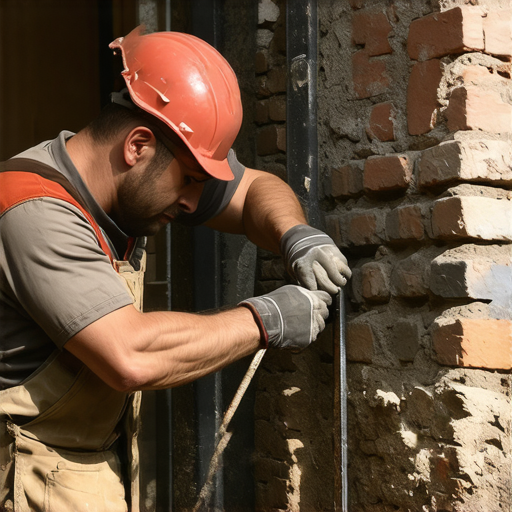
![4 Geogrid Mistakes Ruining Retaining Walls [2026 Checklist]](https://masonryrescue.com/wp-content/uploads/2026/02/4-Geogrid-Mistakes-Ruining-Retaining-Walls-2026-Checklist.jpeg)
4 Geogrid Mistakes Ruining Retaining Walls [2026 Checklist]
The Forensic Scene: A Sixty-Thousand-Dollar Rubble Pile
I stood looking at a sixty-thousand-dollar structural retaining wall in the rolling hills of the Hudson Valley last November. It wasn’t just leaning; it had completely blown out its midsection, spilling tons of saturated clay onto a client’s pristine patio. The homeowner thought it was a ‘drainage issue.’ But when I started the forensic dig, the truth was uglier. I saw the geogrid—the very skeleton of the wall—snapped like cheap fishing line. The contractor had used a grid meant for a garden border on a twelve-foot gravity-defying monster. They hadn’t accounted for the sheer weight of wet earth. This is the reality of modern masonry: if you don’t respect the physics of the soil, the soil will eventually win. You can spend all the money you want on stone balustrade restoration or fancy brick arch restoration, but if the earth behind your wall moves, the whole thing is just expensive trash.
The Anatomy of Stability: Why Geogrid Isn’t Optional
Most ‘pros’ think they can just stack blocks, ‘butter’ a little mud on the edges, and call it a day. They treat geogrid like a suggestion. In my thirty years of pulling a slicker across joints, I’ve learned that geogrid is the only thing that turns a pile of blocks into a monolithic structure. It relies on the ‘angle of internal friction.’ When you lay that polymer mesh, the soil particles lock into the apertures of the grid. It’s like the ‘tooth’ of a stone—without it, there’s no grip. If you’re dealing with a failing retaining wall repair, ninety percent of the time the failure started because someone got lazy with the grid length.
“Geogrid reinforcement must extend into the reinforced soil zone to a length of at least 70% of the total wall height to ensure global stability.” – NCMA Design Manual for Segmental Retaining Walls
Mistake #1: The Short-Grid Shortcut
The most common sin in the industry is the ‘short-grid.’ Contractors try to save a buck by only running the grid two or three feet back into the bank. In 2026, with our increasingly volatile weather patterns and heavy rains, that’s a death sentence for a wall. To perform a proper retaining wall batter correction, you have to understand that the wall isn’t just holding back dirt; it’s resisting lateral earth pressure that increases exponentially with height. I’ve seen brick veneer detachment repair jobs that were easier than fixing a wall with short grids. You have to excavate the entire ‘reinforced zone.’ If your wall is ten feet tall, that grid better be seven feet deep. No excuses. I don’t care if you hit shale or hardpan—you dig it out or you watch the wall bow like a cheap suit.
Mistake #2: Ignoring the Freeze-Thaw Expansion
Up here in the North, water is the enemy. It expands 9% when it freezes. If your drainage isn’t perfect, that water gets trapped in the ‘fines’ of your backfill. This leads to freeze-thaw damage restoration needs that could have been avoided with a simple 12-inch chimney of clean 2B stone. When that water freezes behind the wall, it exerts thousands of pounds of pressure. If you’re using self-healing concrete foundations, you might have some leeway with hairline cracks, but a retaining wall is a different beast. The pressure will pop the faces right off your blocks, a phenomenon we call ‘spalling.’ It’s the same reason we see chimney flue liner installation failures—thermal and moisture expansion that has nowhere to go. You need weep holes every four feet, and you need a perforated pipe that actually daylighted, not just buried in a ‘French drain’ to nowhere.
Mistake #3: Lack of Compaction and the Soil ‘Cold Joint’
You can’t just throw dirt back in and walk on it to pack it down. You need a vibratory plate compactor. Every six-inch ‘lift’ of soil needs to be hammered until it’s at 95% Standard Proctor Density. If you don’t, the soil settles unevenly. This creates a ‘cold joint’ in the earth where water can pool. I’ve seen this happen in brick infill panel repair where the structural backing moves and the masonry stays put—it shears the ties right off. In a retaining wall, poor compaction leads to ‘hydrostatic pressure’ that eventually overrides the geogrid’s tensile strength. You’ll see the wall start to ‘belly’ in the middle. At that point, your tuckpointing cost estimation doesn’t matter because the whole structure needs to be dismantled.
The 2026 Retaining Wall Checklist
Before you hire someone who claims they can do it cheaper, run them through this forensic checklist. If they stumble on the physics, fire them. 1. The 70% Rule: Ensure geogrid length is 0.7x the wall height. 2. Clean Stone Only: No ‘dirt’ allowed within 12 inches of the wall back. 3. Compaction Lifts: No more than 6 inches of soil before the compactor runs. 4. Batter Verification: The wall should lean *into* the hill at a minimum of 1 inch for every 1 foot of height. 5. Grid Continuity: No gaps between geogrid sections along the length of the wall. This isn’t like a brick veneer detachment repair where you can just inject some epoxy and hope for the best. This is heavy-duty engineering. I’ve spent years doing stone balustrade restoration on historic estates, and the one thing that remains constant is that the foundation dictates the future. If the base isn’t solid, the most beautiful brick arch restoration in the world won’t save the building.
“Water penetration and the resulting hydrostatic pressure are the primary catalysts for masonry structural failure.” – ASTM C1552 – Standard Practice for Capping Concrete Masonry Units
The Final Word from the Trowel
Masonry is a trade of patience. Whether you’re calculating a tuckpointing cost estimation for a 19th-century cathedral or installing self-healing concrete foundations for a modern skyscraper, the physics of gravity and moisture don’t change. I’ve seen ‘lick-and-stick’ veneer peel off like a scab because the installer didn’t understand suction. I’ve seen chimney flue liner installation jobs that were fire hazards from day one. But nothing breaks my heart like a massive retaining wall failure. It’s a waste of stone, a waste of fuel, and a danger to everyone nearby. Do it right the first time. Use the right grid. Compact the soil. Respect the water. Or call me in three years when it falls over—I’ll be the one with the forensic scope, telling you ‘I told you so’ while I write the estimate for the demolition.
![Why Sagging Windows Need New Brick Lintels Fast [2026 Fix]](https://masonryrescue.com/wp-content/uploads/2026/02/Why-Sagging-Windows-Need-New-Brick-Lintels-Fast-2026-Fix.jpeg)

This post hits so many critical points that are often overlooked in retaining wall projects. I especially agree with the emphasis on geogrid length—it’s surprising how many contractors try to cut corners here because it seems like a minor detail at the start, but it really underpins the entire structure’s stability. From personal experience, I’ve seen neglecting proper compaction and the ‘cold joint’ issues lead to costly failures. The part about water management caught my attention because in my region, heavy rain can indeed turn a seemingly sound wall into a liability in just a few seasons. We always advocate for thorough drainage solutions and proper backfill material, like the simple but effective 12-inch stone chimney. I’m curious, has anyone here encountered solutions that significantly improved drainage or moisture control in these applications? It seems like the water issues are often the Achilles’ heel of otherwise well-constructed retaining walls.