4 Fire-Rated Masonry Installation Rules for 2026 Safety
The Forensic Scene: When Walls Tell Secrets
The homeowner pointed at a thin, vertical fissure running from the grade to the second-story windowsill. ‘Just a settlement crack,’ he told me. I didn’t say a word. I pulled my fiber-optic scope from my kit and fed it through a weep hole. What I saw wasn’t settlement; it was a slow-motion explosion. The corrugated metal ties, meant to hold the masonry to the framing, had become a mass of iron oxide—swollen to four times their original thickness. This ‘bloom’ was literally jacking the brick skin away from the building. In a fire, that wall wouldn’t have stood for five minutes; it would have peeled off like dry skin. This is the reality of structural masonry inspection in an era where we ignore the hidden bones of our buildings. If you are looking at your home and seeing what you think is a minor blemish, you might actually be looking at a catastrophic failure of the assembly’s fire-rating. As we move toward the 2026 safety standards, the industry is finally waking up to the fact that ‘pretty’ doesn’t mean ‘protected.’
“Water penetration is the single greatest threat to masonry durability.” – BIA Technical Note 7
Rule 1: Structural Brick Ties Replacement and the 2026 Galvanic Standard
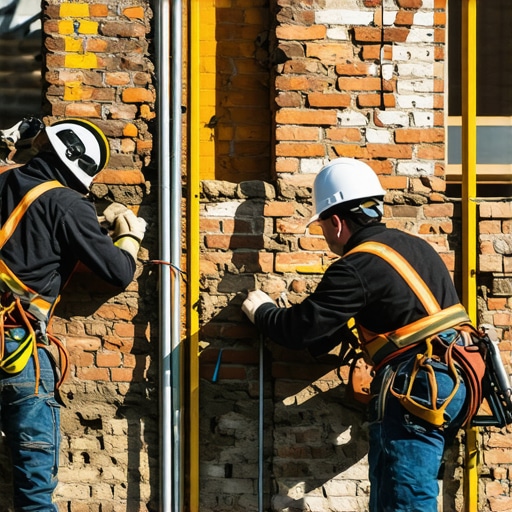
For decades, contractors used thin, galvanized corrugated ties. They are garbage. In the forensics of a failing wall, we see these ties snap like dry twigs because of a process called crevice corrosion. When we talk about structural brick ties replacement for 2026 safety, we are moving toward stainless steel and high-tensile adjustable systems. The physics of a fire-rated wall depends on the wall remaining vertical under extreme thermal stress. When the interior of a building reaches 1,500 degrees Fahrenheit, the studs (even steel ones) begin to move. If your ties are rusted through, the masonry veneer loses its lateral support. It buckles. We now require ties that can handle the differential movement between the hot exterior face and the cooler interior structure. This isn’t just about slapping mud on a wall; it’s about mechanical anchoring that survives the expansion of the masonry skin. If you are doing tuckpointing brick walls without checking the integrity of the ties behind the brick, you are just painting a tombstone.
Rule 2: The Chemistry of High-Performance Mortar Mixes
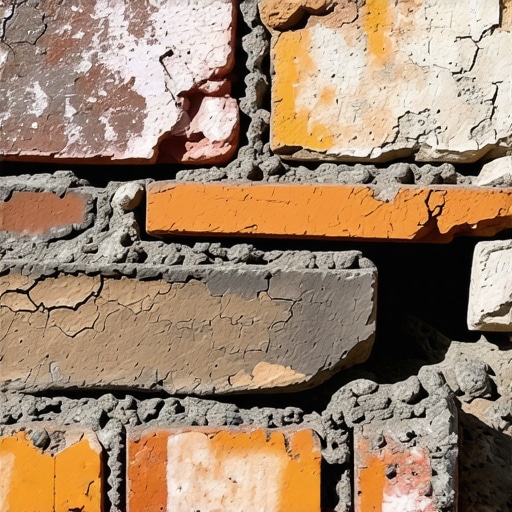
I see it every day: some ‘pro’ shows up with a bag of Type S Portland cement and starts buttering up 100-year-old Chicago common bricks. That is a crime. Those old bricks are soft; they are fired at lower temperatures and have a high porosity. If you use a mortar that is harder than the brick, the brick will lose. We call this the sacrificial principle. In 2026, high-performance mortar mixes are moving back to lime-heavy compositions for restoration and advanced polymers for new fire-rated assemblies. The ‘mud’ on your hawk needs to have a specific vapor permeability. If moisture gets trapped behind a hard, cement-rich joint, the freeze-thaw cycle will turn the brick face into dust. This is ‘spalling.’ When we mix mortar for structural repointing, we are looking for a specific modulus of elasticity. We want the mortar to give, to breathe, and to heal itself through carbonation—where the lime reacts with atmospheric CO2 to seal micro-cracks over decades.
“The fire resistance of a masonry wall is determined by the heat transmission through the assembly and the structural integrity of the units and mortar under high temperatures.” – ASTM C119
Rule 3: Historic Pointing Styles and the Capillary Break
There is a difference between tuckpointing brick walls and repointing. True tuckpointing uses a base mortar matched to the brick color and a thin ‘ribbon’ of contrasting color to create the illusion of perfect, tight joints. It was the original ‘faking it’ of the 19th century. But from a safety perspective, historic pointing styles like the ‘weathered joint’ or the ‘grapevine joint’ serve a functional purpose: shedding water. A ‘recessed’ or ‘raked’ joint looks cool and modern, but it creates a shelf for water to sit on. In a fire-rated assembly, trapped water turns to steam. Steam expands at a ratio of 1,600 to 1. That internal pressure can blow a wall apart during a building fire. When estimating tuckpointing cost estimation, if the contractor isn’t talking about the joint profile’s ability to shed water, they don’t know their craft. You want a ‘slicker’ to pack that mud tight, ensuring there are no cold joints or honeycombing where fire and smoke can bypass the masonry barrier.
Rule 4: Concrete Block Foundation Repair and the Thermal Barrier
Most people think fire safety is about the roof and the walls, but it starts at the grade. Concrete block foundation repair is critical because these blocks often serve as the structural plenum for the entire house. If you have honeycombing—those voids in the concrete where the aggregate didn’t flow correctly—you have a shortcut for fire. When we perform a structural masonry inspection, we look for ‘stair-step’ cracks. These aren’t just ugly; they are breaches in your fire-rated envelope. We are also seeing a major push against stone veneer over brick. This ‘lick-and-stick’ trend is a forensic nightmare. If the stone isn’t bonded with the right polymer-modified mortar, the air gap behind it acts as a chimney during a fire, sucking flames upward behind the facade. For chimney repair services, this is even more critical. The flue liner must be isolated from the masonry shell to prevent thermal bridging, which can ignite framing members three inches away through solid brick.
The Final Verdict: Do It Once, or Do It Twice
You can hire a guy with a bucket and a trowel who promises a low tuckpointing cost estimation, or you can hire a mason who understands the molecular bond of the materials. When you see a soldier course—those bricks standing on end—know that they are under different stress than the stretchers below them. Masonry is a living, breathing system of mass and energy. Whether you are dealing with a failing 1920s chimney or a modern fire-rated commercial wall, the rules of physics do not change for 2026. You respect the suction of the brick, you manage the moisture, and you never, ever use ‘lick-and-stick’ where structural integrity is required. If you ignore the ‘tooth’ of the stone and the chemistry of the mud, you aren’t building a home; you’re building a pile of future rubble. Stick to the standards, demand stainless ties, and make sure your mason knows the difference between Type N and Type O before they ever touch your wall.