4 Brick Infill Panel Repair Fixes to Save Your 2026 Facade
The Forensic Scene: When the Bones Start to Bleed
I remember standing on a swaying forty-foot pump jack in the middle of a November sleet storm, staring at a masonry lintel that had expanded so much it looked like a rusted rib cage bursting out of a chest. The building owner thought it was just a cosmetic hairline crack in the brickwork. But when I slid my borescope into the cavity, the truth was grim: the structural steel was rusted to dust, pushing out the soldier course like a slow-motion explosion. That is the reality of masonry forensics—by the time you see the symptom on the exterior, the disease has been eating the bones of the structure for decades. Infill panels are particularly notorious for this. These non-load-bearing walls are often treated as afterthoughts, yet they are the primary defense against the relentless physics of the environment.
The Physics of the Freeze-Thaw War
In the northern climates, we deal with a phenomenon that most modern ‘handymen’ simply don’t grasp: the 9% expansion of water. When moisture enters a brick through a hairline crack, it settles into the microscopic pore structure. When the mercury drops, that water transitions into a crystalline lattice, demanding more space. If your mortar is harder than your brick—a common sin committed with modern Portland cement—the brick has nowhere to go but out. It pops. It spalls. It shatters. This is why historic tuckpointing isn’t just about ‘making it look pretty.’ It is about the sacrificial principle. Your mortar must be the weakest link in the chain so that it fails before the masonry unit does.
“Water penetration is the single greatest threat to masonry durability. The design must provide for the dissipation of water that enters the wall system.” – BIA Technical Note 7
1. The Foundation Underpinning and Hydrostatic Relief
Before you even touch a trowel to the facade, you have to look at the ground. Most cracked brick wall repair is actually a soil mechanics problem disguised as a masonry problem. When the soil heaves or settles, the infill panel, trapped between rigid structural columns, begins to shear. We call this ‘stair-step cracking.’ If you see a crack following the bed joints and head joints, the building is moving. The fix isn’t more ‘mud.’ The fix is foundation underpinning. We use helical piers to find competent load-bearing strata, effectively bypassing the shifty topsoil that is playing see-saw with your 2026 facade. Without stabilizing the footings, any repair you do to the brickwork is just a temporary Band-Aid on a sucking chest wound.
2. Historic Tuckpointing and the Chemistry of ‘Mud’
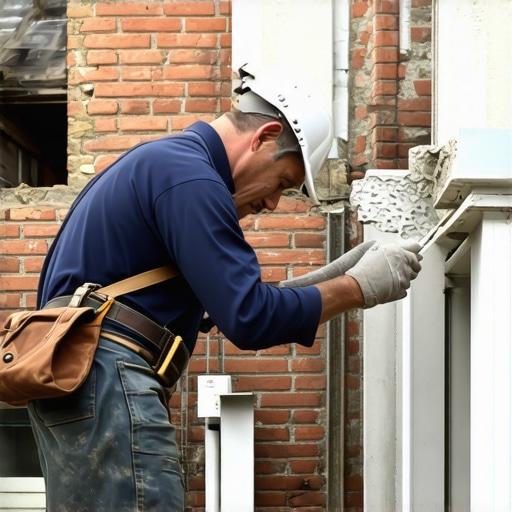
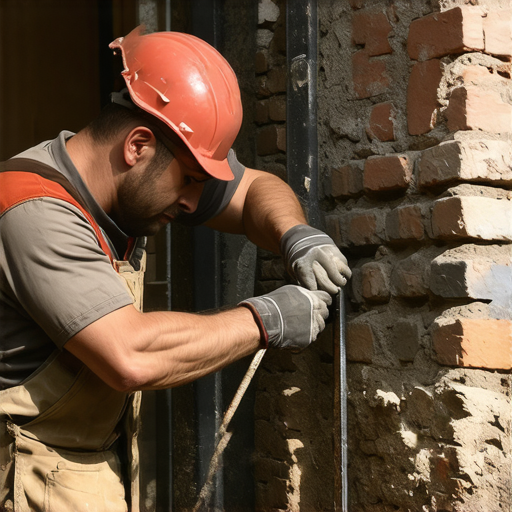
If you are working on a pre-1940s structure, put the bag of Type S cement back in the truck. It is too rigid. For professional masonry restoration, we look at the chemistry of the original material. Old bricks were fired at lower temperatures; they are soft and porous. They need to breathe. We use lime-based mortars (Type O or K) that allow for autogenous healing—the ability of the mortar to actually reseal micro-cracks over time through the carbonation of free lime. When we ‘butter’ a joint, we aren’t just slapping it on. We are ensuring a deep bond. We use a hawk and a slicker to pack the joint tight, eliminating voids where water can hide. If you don’t ‘strike’ the joint properly to shed water, you are just inviting the next freeze-thaw cycle to tear your work apart.
“The use of mortar that is stronger than the masonry units can lead to the deterioration of the units themselves, as the mortar will not accommodate the natural movement of the wall.” – ASTM C270 Standards
3. Masonry Birdsmouth Cuts and Thermal Expansion
Infill panels are often confined by concrete or steel frames. As the sun beats down on a hot July afternoon, those bricks expand. If the mason didn’t account for thermal expansion, the panel will ‘bow’ or ‘blow out.’ This is where masonry birdsmouth cuts and proper expansion joints come into play. We have to create room for the building to breathe and move. Using self-leveling masonry lifts in horizontal joints can provide the necessary cushion. If you are seeing vertical cracks near the corners of your infill panels, it is a sign that the wall is trying to grow and has run out of room. We solve this by retrofitting soft joints—replacing rigid mortar with high-grade backer rods and specialized sealants that match the color of the mortar but offer the flexibility of rubber.
4. Chimney Structural Repair and Flashing Integrity
The chimney is the most vulnerable part of the facade because it is attacked by the elements from all four sides. Chimney structural repair often starts with the flashing. If the lead or copper flashing is compromised, water runs down the interior of the flue, causing ‘honeycombing’ in the mortar joints from the inside out. We see this often in 2026 facade audits—the exterior looks okay, but the core is hollow. We use tuckpointing tools for DIY enthusiasts only for the most basic surface work; for structural chimney repair, we are often looking at a full teardown to the roofline. We rebuild using a soldier course for aesthetic strength, but the real work is the internal lead pans and counter-flashing that redirect water back to the roof surface.
The Master’s Verdict: Do it Once, or Do it Twice
The market is flooded with ‘lick-and-stick’ contractors who think a tube of caulk and a bucket of premixed mortar is a repair kit. It isn’t. Masonry is a game of management—managing water, managing pressure, and managing chemistry. If you want your facade to survive 2026 and the next fifty years after that, you have to respect the materials. Stop trying to ‘seal’ the brick with cheap silicone sprays that trap moisture inside. Instead, focus on the ‘tooth’ of the repair, the suction of the brick, and the proper drainage systems that keep the wall dry. Because in the end, the stone always wins. Your job is just to make sure it doesn’t fall on anyone’s head.