3 Trends for Metallic Masonry Finishes on 2026 Building Facades
The Forensic Reality of Metallic Masonry: Trends, Failures, and the 2026 Horizon
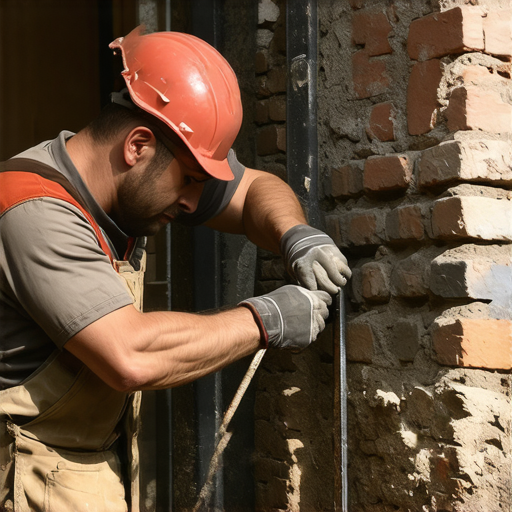
The first time I saw a metallic-finish masonry unit fail, it wasn’t a slow decline; it was a violent separation. I was standing on a suspended scaffold fourteen stories up, looking at a facade that was supposed to be the crown jewel of the district. The homeowner thought it was just a hairline crack. But when I put my scope inside the cavity, I saw the structural steel was rusted to dust, and the high-tech ‘metallic’ glaze was acting like a plastic wrap, trapping moisture until the pressure blew the faces right off the brick. This is the reality of the ‘lick-and-stick’ era meeting the futuristic demands of 2026 aesthetics. We are entering a phase where BIM masonry projects and robotic masonry repair are no longer luxuries—they are the only way to manage the complexity of modern facades.
Trend 1: The Rise of PVD-Coated Masonry and the ‘Bond’ Crisis
In 2026, we’re seeing a massive shift toward Physical Vapor Deposition (PVD) finishes on concrete masonry unit restoration projects. Architects want that titanium or brushed bronze look, but they’re trying to achieve it on a substrate that breathes. This creates a fundamental physics conflict. When you ‘butter’ a standard brick, the suction—the rate at which the brick pulls water from the mud—is what creates the mechanical bond. With metallic-finished units, there is zero suction. We are forced to rely entirely on high-performance mortar mixes that utilize polymer additives to create a chemical bond rather than a mechanical one. If your mason is still using a standard Type S they bought at a big-box store, that metallic facade will be on the sidewalk in three winters.
“Water penetration is the single greatest threat to masonry durability, particularly when non-breathable finishes are applied to porous substrates.” – BIA Technical Note 7
Trend 2: Robotic Precision and BIM-Integrated Forensics
The second trend is the move toward BIM masonry projects where every single metallic-finished unit is tracked by a digital twin. Why? Because these finishes are unforgiving. In the old days, we could hide a slightly off-plumb wall with a bit of clever jointing. You can’t do that with metallic finishes. The way light hits a soldier course of metallic brick will highlight every 1/16th of an inch of misalignment. We are seeing robotic masonry repair systems being used to reach tolerances that the human hand, as much as I love my trade, simply can’t hit consistently over a 50,000-square-foot commercial parapet wall repair. These robots don’t get tired, and they don’t ‘short-change’ the mud in the middle of a hot July afternoon.
Trend 3: Self-Healing Mortars for Metallic Facades
The third and perhaps most critical trend is the integration of crystalline technology into high-performance mortar mixes. In the freeze-thaw cycles of the North, water is the assassin. It expands 9% when it turns to ice. If that water gets behind a metallic finish and freezes, the spalling is catastrophic. The industry is moving toward mortars that can actually ‘heal’ micro-cracks before they become failure points. This is essential for brick wall restoration where we are trying to marry 21st-century finishes with older, movement-prone structures. Without these advanced mixes, the retaining wall installation of tomorrow, specifically those utilizing metallic-finished blocks, would succumb to hydrostatic pressure within a decade.
Micro-Zooming: The Chemistry of the Cold Joint
Let’s talk about ‘honeycombing’ and the ‘cold joint.’ When you’re pouring concrete flatwork services or filling a reinforced masonry cell, if the vibration isn’t perfect, you get pockets of air. In a standard wall, it’s a problem. In a metallic-finish wall, it’s a death sentence. The metallic coating creates a thermal bridge. The face of the unit gets significantly hotter than the core, causing differential thermal expansion. I’ve seen brick efflorescence removal jobs turn into full-scale retaining wall block replacement projects because the salt migration was accelerated by this heat, blowing the metallic ‘skin’ right off the ‘bone’ of the block. You have to understand the C-S-H (Calcium Silicate Hydrate) gel formation at a molecular level to realize why a standard mortar joint won’t survive the shear stress of a metallic facade’s expansion.
“The selection of mortar must be based on the physical properties of the masonry unit and the environmental exposure conditions.” – ASTM C270 Standard Specification
The Forensic Inspector’s Verdict
If you’re looking at concrete masonry unit restoration for a building with these 2026 metallic trends, don’t hire a ‘slicker’ who just knows how to make a joint look pretty. You need a forensic approach. You need to ensure the commercial parapet wall repair includes proper flashing and weep holes that aren’t clogged with ‘droppings.’ I’ve walked onto too many jobs where the ‘hawk’ and ‘trowel’ were used by someone who didn’t understand that a metallic brick is essentially a giant heat sink. Do it once, or do it twice. In my world, doing it twice means someone’s insurance company is calling me to explain why fifty tons of ‘metallic’ masonry is lying in the parking lot. Respect the physics, embrace the BIM, and for heaven’s sake, don’t skimp on the high-performance mortar mixes.

Reading through this post, I was particularly struck by the emphasis on the use of self-healing mortars incorporating crystalline technology for metallic facades. In my experience working on restoration projects in colder climates, water infiltration and freeze-thaw cycles pose a persistent threat to long-term durability. These advanced mortar mixes seem like an essential upgrade, especially for buildings with intricate metallic finishes where issues like micro-cracking can escalate quickly. However, implementing these solutions raises a practical question—how do we effectively monitor these mortars over time to ensure they perform as intended, particularly when embedded behind metallic finishes that are difficult to inspect visually? It would be interesting to hear from others who have started adopting these technologies—what have your long-term observations been regarding their effectiveness in real-world scenarios? Do the costs outweigh the benefits at this stage, or is this the way forward for preserving such complex facades?