3 Stone Facade Restoration Fixes for Aging 2026 Exteriors
The Ghost in the Wall: Why Your Stone is Screaming
Old Man Miller used to say that a stone wall has a pulse, and if you don’t believe him, just put your ear to a damp limestone block in October. Miller was a first-generation quarryman who didn’t care for blueprints; he cared about the ‘tooth’ of the stone. I remember him dragging a rusted slicker across a freshly laid bed of mud. If the mortar didn’t grab the stone with a specific, grainy rasp, he’d make us tear the whole course down. He knew that the bond isn’t just sticky—it’s a molecular handshake. Today, I see ‘professional’ stone facade restoration crews slapping high-strength Portland cement onto 80-year-old brownstone, and it makes my teeth ache. They are suffocating the building. By 2026, many of the hasty builds from the early 2020s are starting to show their true colors: efflorescence, spalling, and vertical shear cracks that you could park a truck in. We are entering an era of reckoning for ‘lick-and-stick’ masonry.
“Mortar should always be weaker than the masonry units it binds, acting as a sacrificial element to protect the stone from internal stresses.” — ASTM C270 Standard Specification
1. The Breathability Protocol: Sustainable Tuckpointing Mortars
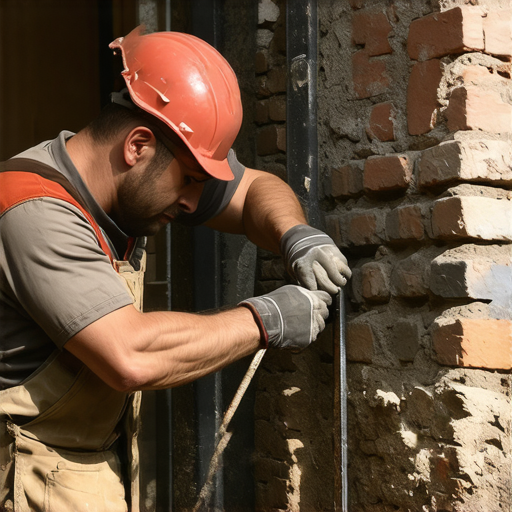
The first fix for an aging facade isn’t more cement; it’s the right mud. When we talk about tuck pointing services, most homeowners think it’s just cosmetic. It’s not. It’s a respiratory treatment. Traditional stone is porous. It breathes. When you use a modern, hard mortar (Type S or M) on old, soft stone, you create a trap. Water enters the stone, tries to escape through the joint, hits a wall of hard cement, and stays there. When the first frost hits, that water expands by 9%, and pop—the face of your expensive stone facade ends up on the sidewalk. This is called spalling, and it’s a death sentence for aesthetics. The 2026 standard for high-end stone facade restoration requires sustainable tuckpointing mortars, often lime-based (Type O or K). These mortars are flexible. They allow for the thermal expansion of the wall without cracking the stone units. To do this right, you have to grind out the old, failing joints to a depth of at least twice the width of the joint. You don’t just ‘butter’ the edges; you pack it in with a hawk and slicker, ensuring there are no voids where water can pool and start the freeze-thaw cycle all over again.
2. The Skeleton Fix: Foundation Underpinning and Waterproofing
You can’t fix a face if the spine is collapsing. I’ve performed hundreds of structural masonry inspections where the homeowner complained about a cracked lintel, only for me to find that the entire corner of the house was sinking. In 2026, we are seeing the results of soil shifting from extreme weather patterns. Foundation underpinning is no longer just for historic monuments; it’s becoming a necessity for residential preservation. We’re moving away from simple concrete pads toward helical piers—steel screws that we drive deep into the load-bearing strata of the earth. Once the house is stabilized, we address the foundation waterproofing. Most people think a coat of tar is enough. That’s a joke. True waterproofing involves a dimpled drainage membrane that creates an air gap against the masonry, allowing hydrostatic pressure to dissipate. Without this, that water is going to find its way into your basement, carrying minerals with it that cause ‘honeycombing’—a process where the concrete or stone literally dissolves from the inside out. We use BIM masonry projects (Building Information Modeling) to map these stresses before we even break ground, allowing us to see exactly where the weight of the stone facade is shifting during settlement.
“The sand must be of good quality, not containing earth or dust, and should be sharp to the touch.” — Vitruvius, De Architectura
3. The Hydrology of the Wall: Weep Holes and Capstones
The most overlooked failure in modern masonry is the retaining wall. I’ve seen $100,000 landscapes ruined because of a clogged 50-cent plastic pipe. Retaining wall weep hole cleaning is the ‘oil change’ of masonry maintenance. If those holes are blocked by silt or spiders, the wall becomes a dam. Water weight is immense; it will push a stone wall over like it’s made of playing cards. Alongside cleaning, we focus on retaining wall capstone replacement. The capstone is the umbrella of your wall. If it’s cracked or lacks a proper drip edge, water will seep behind the stone veneer and rot the substrate. We now use high-performance sealants and ensure every capstone has a 1-inch overhang with a hand-cut ‘reglet’—a small groove on the underside that forces water to drop off before it hits the wall face. For chimneys, which act like giant vertical straws for moisture, chimney leak detection is paramount. We use thermal imaging to find where the flashing has failed or where the masonry has become saturated. Often, it’s not the brick that’s failing, but the lack of a ‘soldier course’ or proper crown to shed water away from the flue. By integrating these forensic fixes, we aren’t just repairing; we are engineering the masonry to last another century. Done right, you’ll never see me again. Done wrong, and I’ll be back in five years with a jackhammer and a much higher bill.