3 Drainage Upgrades to Fix Your Leaning Retaining Wall in 2026
The Anatomy of a $50,000 Pile of Rubble
I stood looking at a $50,000 retaining wall that lay in a pile of rubble because the contractor forgot one thing: drainage. It was a clear Tuesday morning when the homeowner called me, his voice shaking. He’d spent a fortune on a multi-tiered backyard oasis, complete with an outdoor kitchen masonry build and a stone balustrade restoration that would make a Roman senator weep. But three years later, the primary gravity wall didn’t just lean; it surrendered. The failure wasn’t in the stones themselves—they were high-quality granite—it was in the invisible enemy behind them. As a third-generation mason, I can tell you that a wall is only as good as the water it lets go of. When I dug into the failure site, the soil behind the wall was a slurry of grey muck. There was no clean stone, no pipe, just the heavy, suffocating weight of saturated earth that had turned into a hydraulic ram.
“Water penetration is the single greatest threat to masonry durability. Proper drainage systems are not optional; they are the fundamental requirement for structural longevity.” – BIA Technical Note 7
Most folks see a leaning wall and think they need more ‘mud’ or a thicker stone. They’re wrong. You’re fighting physics, not just gravity. In 2026, we’re seeing a shift toward high-performance forensic masonry that addresses the root cause of ‘creeping’ walls. If your wall is bowing, you’re likely witnessing hydrostatic pressure—the literal weight of water trapped in the soil. Soil, when dry, has internal friction. When it’s saturated, that friction disappears, and the lateral load on your wall triples. If you’re in a freeze-thaw climate, you’re also fighting the 9% expansion of water as it turns to ice. That expansion doesn’t just push; it scours and snaps the bond between your mortar and your stone, leading to the need for extensive mortar repointing services or total reconstruction.
1. The Advanced Weep Hole: Hydrostatic Relief Ports
The first upgrade is the most basic, yet most often botched. A standard ‘weep’ is just a gap in the head joint. But in a forensic repair, we use 2-inch PVC or specialized ‘wick’ inserts every 4 feet along the base. The physics here is about the ‘path of least resistance.’ If water can’t find a way out, it will find a way through—usually by popping the face off your stone or pushing the entire structure off its footing. In high-end stone facade restoration, we ensure these ports are screened to prevent ‘honeycombing’ of the backfill, where fine soil particles wash out and create voids. I’ve seen commercial smokestack repair jobs where the same principle of internal moisture relief saved a structure from a catastrophic vertical split. If your wall is leaning, we often retro-drill these ports through the existing masonry, using diamond-core bits to avoid shattering the surrounding ‘mud’.
2. The Chimney Drain: Graded Aggregate Filtration
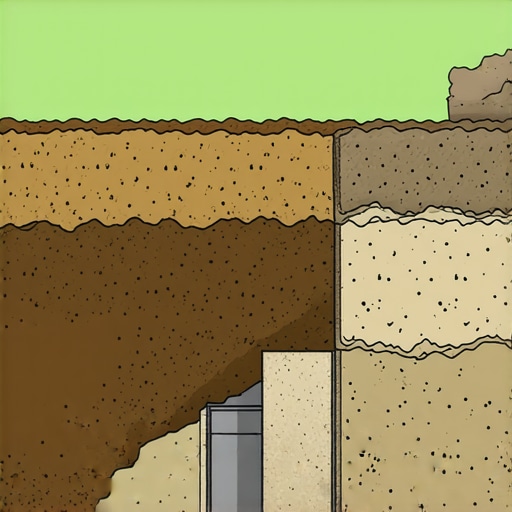
If you’re planning an outdoor fireplace rebuild or a new retaining structure, the ‘Chimney Drain’ is your best friend. Instead of just throwing dirt back behind the wall, we install a 12-to-18-inch vertical column of #57 clean-washed stone. This aggregate has a high ‘void ratio,’ allowing water to drop straight down to the collector pipe rather than pushing against the masonry. The ‘tooth’ of the stone must be sharp; rounded river rock is for decoration, not structural drainage. We wrap this stone ‘chimney’ in a non-woven geotextile fabric. Think of it as a coffee filter. It lets the water through but keeps the ‘fines’ (the tiny dirt particles) out. Without this, your drainage stone will eventually clog with silt, becoming as solid and impermeable as a block of concrete. This is the same logic we apply to concrete flatwork services—the base is everything. If the base moves, the surface cracks.
“Retaining walls must be designed to resist the lateral pressure of the retained material, including any surcharge loads and hydrostatic pressure.” – ASTM C1776 Standard Specification
3. Impermeable Capping and Swale Integration
The best way to manage water is to never let it get behind the wall in the first place. Many homeowners ignore the ‘cap’ or the top course of the wall. In 2026, we are emphasizing the ‘clay cap’ or an impermeable liner buried six inches below the surface at the top of the wall. This liner should slope away from the masonry into a landscaped swale. By redirecting surface runoff before it can infiltrate the backfill, you reduce the load on your French drain by 70%. When we perform foundation waterproofing, we use similar membranes to steer the ‘shelf’ of water away from the structure. This is critical if you have a brick paver driveway repair project adjacent to your wall; if the driveway isn’t pitched correctly, it acts as a funnel, dumping thousands of gallons of water directly into the soil behind your retaining structure. Even a fire-rated masonry installation in a commercial setting requires this attention to surface water management to prevent thermal-moisture shock.
Forensic Identification: When to Rebuild vs. Repair
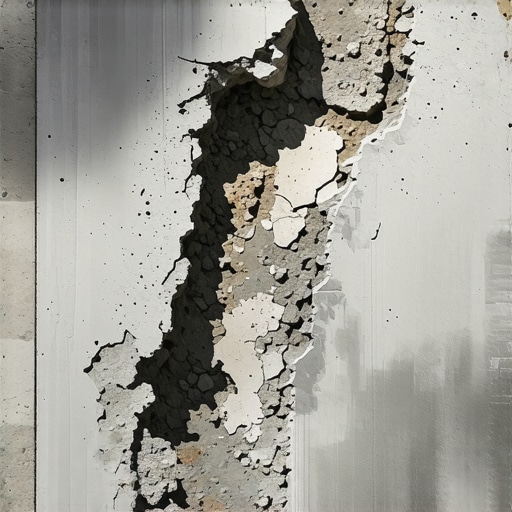
How do you know if your wall can be saved? Look for the ‘Stair-step’ crack. If the crack follows the mortar joints, you might be able to save it with helical piers and mortar repointing services. But if the crack shears directly through the stone or brick, the structural integrity is gone. This is ‘shear failure,’ and it means the internal stresses have exceeded the material’s compressive strength. When I’m ‘buttering’ a joint during a repair, I can feel the ‘suction’ of the stone. If the stone is ‘dead’—meaning it’s saturated and crumbly—no amount of new ‘mud’ will save it. You have to cut your losses. Whether it’s an outdoor kitchen masonry build or a massive commercial wall, the rules of the ‘Old World’ still apply: respect the water, or the water will humble you. Don’t let a ‘handyman special’ ruin your property value with cheap ‘lick-and-stick’ solutions. Do it once, do it right, and let the wall breathe.